
app development cost in india: UI budget guide
Estimate Indian app UI, flow and build costs in INR, account for 18% GST, and define localisation scope before requesting agency quotes.

The app development cost in india depends first on interface scope: a focused MVP can need roughly ₹1.5–5 lakh for design and build, while multi-flow products cost materially more. Budget UI/UX separately, add 18% GST to taxable agency invoices where applicable, and prototype key flows before comparing Indian studio quotations.
Key takeaways
- •Ask for separate INR line items for discovery, UI/UX design, development, QA and post-launch work; a single total hides scope risk.
- •A one-flow MVP and a marketplace, delivery or payments product are not comparable estimates: flow count, states and integrations drive both design and build effort.
- •Treat 18% GST as a typical addition to a taxable Indian agency invoice, then confirm the invoice treatment with the agency or tax adviser.
- •Prototype the key flows in floow.design before procurement so Indian agencies price the same screens, states and handoffs.
What's on this page
- •Price the interface before pricing the build
- •Why familiar Indian apps create larger estimates
- •Localisation and tax belong in the first estimate
- •Use a prototype to make quotations comparable
Price the interface before pricing the build
For mobile app development cost in india, start with a priced scope rather than asking for “an app like” a well-known product. A practical Indian agency estimate separates three phases:
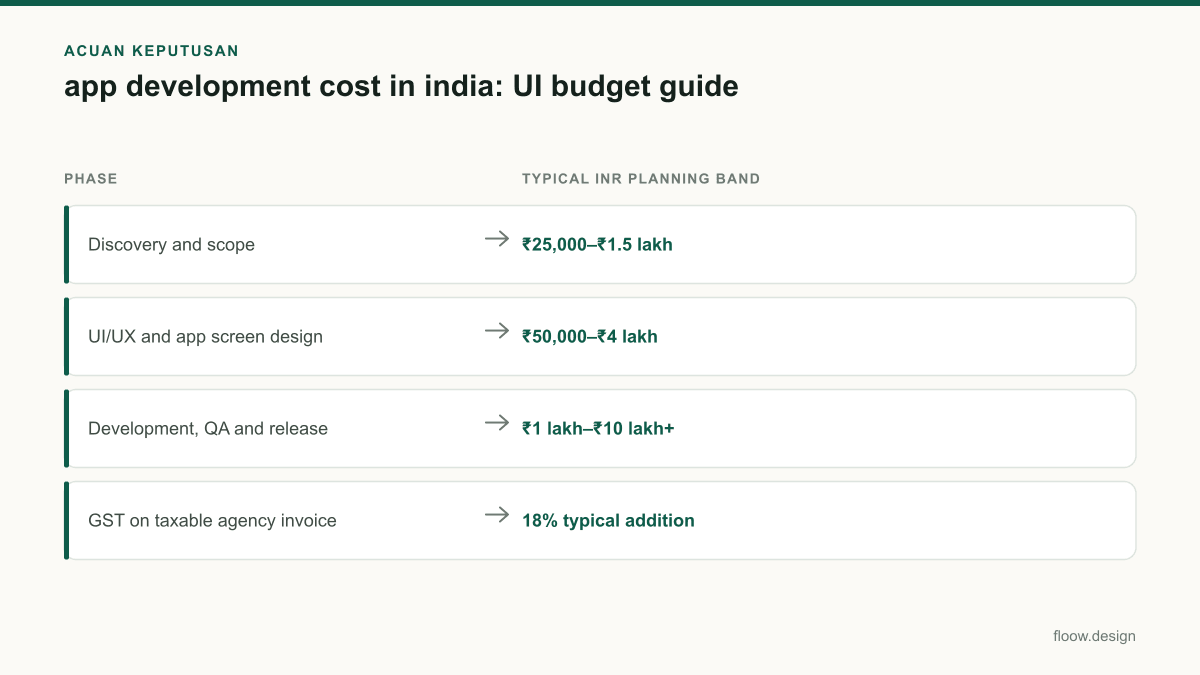
- •Discovery and price definition: roughly ₹25,000–₹1.5 lakh for requirements workshops, user flows, feature prioritisation and a delivery estimate.
- •UI/UX and app screen design: roughly ₹50,000–₹4 lakh for an MVP, depending on the number of unique screens, responsive states, prototype depth and design-system work.
- •Development, QA and release: roughly ₹1 lakh–₹10 lakh+ for a focused MVP, with native integrations, multiple roles and complex back-office needs moving the figure upward.
These are planning bands, not a tariff: a studio should quote against a written scope. A simple booking flow may reuse a small set of components. A product with onboarding, search, cart, payment, order tracking, support and profile settings has many more states to design and test. Ask each agency to state what is excluded—content, API work, payment setup, analytics, app-store release, maintenance and change requests—before comparing totals.
Why familiar Indian apps create larger estimates
Swiggy and Zomato are useful scope references because their experience is not one customer journey. Discovery, location selection, restaurant lists, menus, customisation, cart, checkout, live order status, cancellations, ratings and support all create separate app screen design and engineering states. Restaurant or delivery-partner operations add further flows.
PhonePe illustrates a different kind of complexity. A payments product must make account and payment steps understandable, surface transaction status clearly and account for error, pending and retry conditions. Do not use the visual simplicity of a home screen as a proxy for the cost of the underlying flow.
When briefing an Indian studio, count journeys rather than screens alone. Define the roles involved, entry points, happy paths, empty states, validation, payment failures, permissions, notifications and support handoffs. One polished screen can be reused; one unplanned exception can require changes across several screens and services. Put these items in the quote sheet so a lower bid is not merely omitting them.
Localisation and tax belong in the first estimate
Localisation can change both design and development scope in India. If the product will support more than English, budget for translated interface copy, text expansion, font coverage, language selection, right content hierarchy and QA for every language. Also decide early how Indian names, addresses, phone numbers, PIN codes, payment choices and consent copy appear in the flow. These are interface decisions, not a late translation pass.
For invoicing, GST at 18% is a typical addition to taxable agency invoices in India. Keep GST separate from the pre-tax project value in your approval sheet: a ₹3 lakh taxable service quote, for example, becomes ₹3.54 lakh including 18% GST. The agency’s registration status, place of supply and the buyer’s circumstances can affect the invoice treatment, so obtain the tax wording and GSTIN from the supplier and confirm it with the relevant finance adviser. The Central Board of Indirect Taxes and Customs publishes GST information at https://www.cbic.gov.in/.
Also specify whether content, translation, customer support operations and legal review are included; each can alter the delivered scope.
Use a prototype to make quotations comparable
Before requesting final proposals, prototype the key flows in floow.design. For an MVP, that usually means onboarding, sign-in or account creation, the core task, confirmation, notifications or status, profile and the most important error path. Add the roles that matter: customer, provider, courier, merchant or admin-facing mobile user where relevant.
Give each Indian agency the same prototype, feature list and acceptance criteria. Request an INR quote that identifies discovery, UI/UX, frontend, backend, integrations, QA, release support, project management and GST separately. Ask for the assumed number of revision rounds and what happens when a new flow is added after approval.
This process does not eliminate change, but it reduces ambiguous UI scope. An agency can estimate a defined checkout, order-status or payment-retry journey more credibly than a sentence saying “similar to Swiggy” or “like PhonePe.” It also lets you decide what belongs in version one: preserve the core journey, defer lower-value settings and edge cases only when their absence will not break user trust or operations.
Indicative pre-GST planning bands for an India-based mobile MVP
| Phase | Typical INR planning band | What the quote should define |
|---|---|---|
| Discovery and scope | ₹25,000–₹1.5 lakh | User roles, feature list, flows, assumptions and exclusions |
| UI/UX and app screen design | ₹50,000–₹4 lakh | Unique screens, component library, prototype, revisions and localisation |
| Development, QA and release | ₹1 lakh–₹10 lakh+ | Platforms, backend, integrations, test scope, deployment and warranty |
| GST on taxable agency invoice | 18% typical addition | Whether quoted values are pre-tax or tax-inclusive and the supplier GSTIN |
Common mistakes
Comparing a fixed-price quote for a basic MVP with a quote that includes every Swiggy- or Zomato-style operational flow.
Use one flow inventory and mark each journey as launch, later phase or excluded before collecting quotes.
Treating UI/UX as decoration and approving development before validation, empty and error states are specified.
Fund discovery and a clickable prototype first; price the design system, key states and handoff explicitly.
Approving a pre-tax number as the total budget.
Show the agency fee and 18% GST separately for taxable services, then confirm the final tax treatment on the supplier invoice.
Adding Indian language support after layouts and content are signed off.
List languages, translation ownership, font requirements and localisation QA in the initial scope.
Frequently asked questions
What is the app development cost in india?
The app development cost in india varies with the number of user flows, platforms, integrations and operational roles. As an indicative India-based MVP planning range, discovery may be ₹25,000–₹1.5 lakh, UI/UX ₹50,000–₹4 lakh, and development, QA and release ₹1 lakh–₹10 lakh or more, before applicable GST. A written flow-by-flow scope is needed for a reliable quote.
How much of an app budget should go to UI UX design?
For an Indian mobile MVP, reserve a visible UI/UX line item rather than applying a fixed percentage blindly. A practical planning band is roughly ₹50,000–₹4 lakh, depending on flow count, prototype depth, component reuse, languages and edge states. Products with checkout, live status or payment failures need more design effort because each state affects build and QA work.
Does GST apply to app development services in India?
GST can apply to app development services in India, and 18% is a typical addition to a taxable agency invoice. Treat the quoted project fee and GST as separate approval lines, then verify the supplier’s GST registration, invoice wording and place-of-supply treatment with the agency or a qualified tax adviser. GST guidance is published by CBIC at https://www.cbic.gov.in/.
How can I reduce ambiguity in an Indian agency app quote?
Reduce ambiguity by giving every agency the same clickable prototype, user-flow list, role definitions and acceptance criteria. Prototype onboarding, the core task, confirmation, status, errors and support handoffs in floow.design first. Then ask for separate INR line items for discovery, UI/UX, development, QA, integrations, release support, revisions and GST where taxable.
Where this leaves you
A credible Indian app budget starts with defined journeys, not a competitor screenshot. Prototype the key flows in floow.design, obtain phase-by-phase INR estimates, include localisation requirements, and assess 18% GST separately on taxable agency invoices before selecting a studio.
Design the screens first
Describe the app in plain language and floow.design draws the iOS and Android screens for you, ready to refine and hand off.
Sources
Design your mobile app with AI.
Generate pixel-perfect iOS and Android screens in seconds, then export to Figma or code.
You might also like…
 Insights20 September 2026mobile app development cost in india by app typeEstimate Indian mobile app budgets for commerce, delivery, travel and fintech, including UPI flows, Android-first scope and UI complexity.By floow.design Team, Mobile Design
 Insights20 September 2026app development cost: India scope calculatorEstimate app development cost in India by scoping mobile UI screens, UPI, GST invoices and identity flows before comparing Indian build proposals for an MVP.By floow.design Team, Mobile Design
 Insights20 September 2026ui ux design course fees in India: compare costsCompare Indian UI/UX course fees, GST on invoices, curriculum depth, mentorship, placement claims and portfolio value before enrolling.By floow.design Team, Mobile Design