
mobile app development cost in india by app type
Estimate Indian mobile app budgets for commerce, delivery, travel and fintech, including UPI flows, Android-first scope and UI complexity.

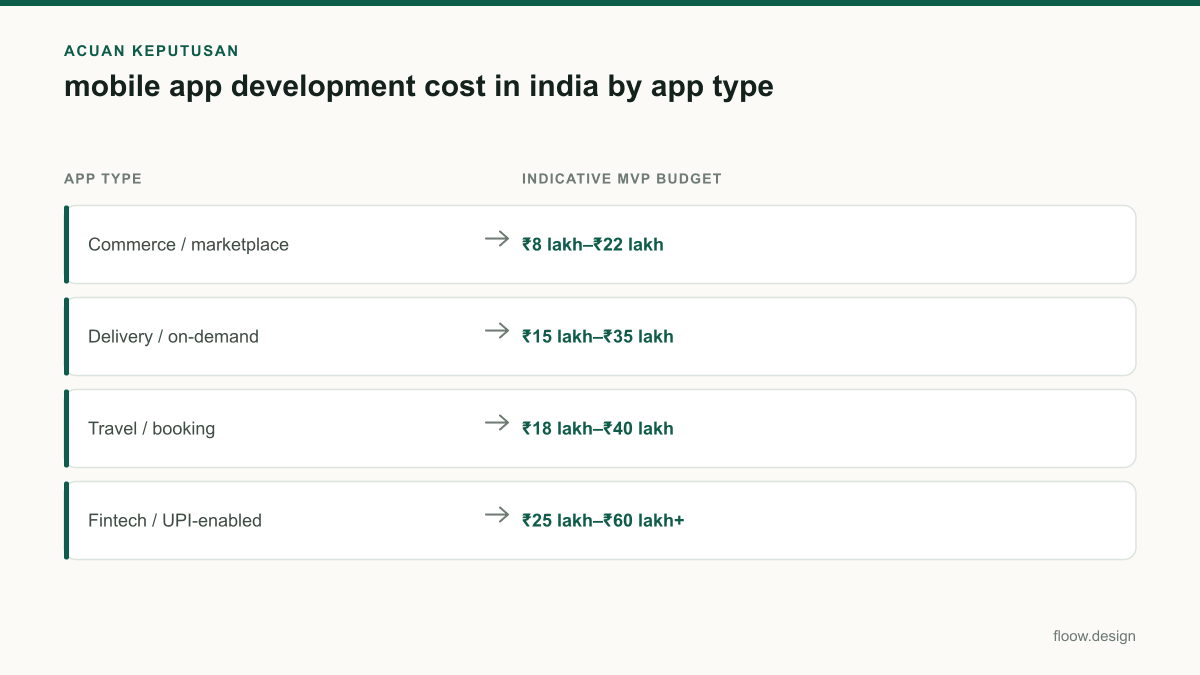
The mobile app development cost in india typically depends on the vertical’s screen count, user roles, backend integrations and compliance work. For an MVP, plan roughly ₹8 lakh–₹60 lakh+: commerce apps sit at the lower-to-mid range, while delivery, travel and fintech rise with live operations, bookings, UPI and RBI-regulated payment-provider integration.
Key takeaways
- •A useful Indian MVP estimate starts with flows and roles, not a single per-screen price.
- •Commerce apps need catalog, search, cart and checkout; delivery adds live order operations; travel adds inventory and booking states; fintech adds regulated payment scope.
- •UPI is not just a payment button: collect requests, status handling, failed-payment recovery and provider integration change the estimate.
- •Android-first can reduce first-release scope, but it does not remove backend, payment, QA or operational-screen costs.
What's on this page
- •Indian app budgets by vertical and UI scope
- •What makes ecommerce app design more or less expensive
- •UPI and fintech scope: budget the payment journey, not a single screen
- •Android-first: lower first-release scope, not a shortcut
- •Turn a concept into an estimate with floow.design
Indian app budgets by vertical and UI scope
For planning, treat these as MVP delivery ranges in INR, not fixed market rates. A small team can price lower when it reuses proven patterns; a custom design system, complex integrations or a production-grade operations layer will push the budget up.
A commerce app in the style of Meesho needs product discovery, filters, product detail, cart, address selection, checkout, orders and account states. Its cost is driven by catalog depth, seller or reseller roles, promotions and checkout edge cases. A delivery app comparable in operating model to Swiggy needs customer ordering plus merchant, courier and support workflows; real-time order status and location-related states increase both interface and engineering effort.
A mobility app such as Ola adds ride booking, pickup selection, driver matching, trip states, cancellation and safety/support paths. Travel products in the category of MakeMyTrip need date search, traveller details, inventory results, fare rules, booking confirmation and change or cancellation journeys. Fintech usually has fewer decorative screens but higher effort around identity, transaction history, payment states and regulated integrations.
What makes ecommerce app design more or less expensive
Ecommerce app design becomes expensive when the team designs only the happy path. Indian shopping flows need to account for address entry and edit, delivery availability, out-of-stock substitutions or unavailable variants, coupon validation, order tracking, cancellations, refunds and customer support. A marketplace also needs distinct seller, reseller or catalogue-management states when those roles are in the mobile product.
Keep the first release focused: choose one primary discovery pattern, limit filter combinations, define a small type scale and reusable cards, and use a component library for buttons, inputs, bottom sheets, payment rows and order-status modules. This lowers implementation rework across Android screen sizes.
The estimate should separately identify customer screens, internal operational screens and backend-connected states. A polished product card is relatively contained; a checkout connected to inventory, shipping, tax, promotions and payments is not. Ask for a flow-level estimate that marks what is static UI, what needs an API, and what needs failure, loading and empty states. That distinction makes an app development cost in india proposal comparable across vendors.
UPI and fintech scope: budget the payment journey, not a single screen
For a UPI-enabled product, scope the full payment journey: selecting UPI, handing off or initiating the payment route supported by the chosen provider, pending status, success, failure, cancellation, duplicate-attempt protection, transaction reference display and help or dispute entry points. The interface must make payment status unambiguous; a shopper should never be asked to place the same order again simply because a callback is delayed.
The commercial estimate also changes according to who is handling payments. RBI-regulated payment-provider integration can require provider onboarding, security review, API work, reconciliation and careful test coverage. Do not assume that a generic payment UI automatically makes an app ready to process UPI transactions. The Reserve Bank of India publishes payment-system regulation and directions, while NPCI publishes UPI product information and participating ecosystem guidance at their official sites.
For a fintech MVP, put transaction history, payment-state recovery, consent or authentication steps where applicable, and support escalation into the prototype before seeking quotes. These screens are often omitted from early mock-ups and then added during build, which is why fintech ranges are higher than a simple content or catalog app.
Android-first: lower first-release scope, not a shortcut
An Android-first release can be cheaper because the team designs, develops and tests one native platform before adding iOS. For an Indian launch, it is a practical way to validate the core purchase, booking or payment flow with a narrower device and release scope. It is not automatically half the cost: APIs, admin tools, analytics, payment integration, design foundations, QA and production monitoring still need to be built.
Define the Android baseline early: supported OS versions, low-memory behaviour, image-loading rules, network-loss states, device sizes and accessibility requirements. Android’s official developer guidance is the right reference for platform behaviour and design implementation decisions. If iOS is planned next, keep navigation rules, tokens, copy, error patterns and components platform-aware rather than hard-coding Android assumptions into every screen.
For pricing, request three numbers: Android MVP, Android MVP plus the required internal operations screens, and a later iOS adaptation. That exposes whether a low quote has excluded the screens that make a delivery, travel or payment flow work in production.
Turn a concept into an estimate with floow.design
Create an MVP flow in floow.design to identify the screens that drive the mobile development estimate. Start with one user goal: buy a product, order delivery, book a trip or make a payment. Then map every state that can change the outcome: onboarding, sign-in, search, selection, address or traveller details, review, payment, confirmation, tracking, cancellation and support.
For a Meesho-like commerce concept, include discovery, product detail, cart, checkout and order tracking. For a Swiggy-like delivery concept, add restaurant or merchant availability, order acceptance, rider or courier status and issue reporting. For Ola-like mobility, map pickup, matching, trip and post-trip support. For a MakeMyTrip-like journey, include search, results, fare details, traveller information, booking and itinerary management.
Share the resulting flow with development partners and ask them to label each screen as front-end only, API-connected, map or location-dependent, payment-related, or operational. That produces a more defensible budget than asking for a quote from a headline alone.
Indicative India MVP planning ranges by app type
| App type | Indicative MVP budget | UI and delivery scope that moves the range |
|---|---|---|
| Commerce / marketplace | ₹8 lakh–₹22 lakh | Catalog, search, product detail, cart, address, checkout, orders; seller or reseller roles and promotions increase scope. |
| Delivery / on-demand | ₹15 lakh–₹35 lakh | Customer ordering plus merchant, courier, live-status, support and operations workflows. |
| Travel / booking | ₹18 lakh–₹40 lakh | Search inventory, date and traveller inputs, fares, booking, itinerary, changes and cancellations. |
| Fintech / UPI-enabled | ₹25 lakh–₹60 lakh+ | Payment states, transaction history, security-sensitive flows, reconciliation and RBI-regulated payment-provider integration. |
Common mistakes
Quoting only the customer-facing happy path
Include loading, empty, error, retry, cancellation, refund and support states, plus the internal screens needed to operate the service.
Treating UPI as one checkout button
Estimate pending, success, failure, cancellation, callback handling, transaction references and payment-provider integration as separate scope.
Using a marketplace reference without defining the business model
State whether the product is a single-store shop, multi-vendor marketplace, reseller model or service aggregator before estimating roles and screens.
Assuming Android-first removes cross-platform planning
Build shared content, design tokens and backend contracts for later iOS adaptation, while pricing Android implementation and QA separately.
Frequently asked questions
What is the mobile app development cost in india?
The mobile app development cost in india for an MVP commonly ranges from about ₹8 lakh to ₹60 lakh or more, depending on the app type. A basic commerce flow is usually less costly than delivery, travel or fintech because those products add operational roles, live status, booking inventory, UPI payment handling or regulated provider integration.
How much does a UPI-enabled app cost to design and build?
A UPI-enabled Indian app MVP may require roughly ₹25 lakh–₹60 lakh+ when it includes payment status handling, transaction history, failure recovery, backend reconciliation and RBI-regulated payment-provider integration. The final cost depends on whether UPI is a checkout option in a commerce app or the central function of a fintech product.
Is Android-first cheaper for an Indian app launch?
Android-first is usually cheaper for an Indian app launch because the initial team designs, builds and tests one mobile platform rather than two. It does not eliminate backend APIs, payment work, operational tools or QA. Keep the design system and API contracts ready for iOS if a second-platform release is planned.
Which screens should be included in an Indian app MVP estimate?
An Indian app MVP estimate should include the core task flow and its exceptions: onboarding, sign-in, discovery, selection, checkout or booking, payment status, confirmation, tracking, cancellation, support, loading and error states. Add merchant, courier, seller or admin workflows when the service cannot operate without them.
Where this leaves you
Use the ranges as a planning starting point, then create the MVP flow in floow.design. The screens, roles and exception states in that flow—not the app category name alone—determine the credible Indian development estimate.
Design the screens first
Describe the app in plain language and floow.design draws the iOS and Android screens for you, ready to refine and hand off.
Sources
Related reading
Design your mobile app with AI.
Generate pixel-perfect iOS and Android screens in seconds, then export to Figma or code.
You might also like…
 Insights20 September 2026app development cost in india: UI budget guideEstimate Indian app UI, flow and build costs in INR, account for 18% GST, and define localisation scope before requesting agency quotes.By floow.design Team, Mobile Design
 Insights20 September 2026app development cost: India scope calculatorEstimate app development cost in India by scoping mobile UI screens, UPI, GST invoices and identity flows before comparing Indian build proposals for an MVP.By floow.design Team, Mobile Design
 Insights20 September 2026ui ux design course fees in India: compare costsCompare Indian UI/UX course fees, GST on invoices, curriculum depth, mentorship, placement claims and portfolio value before enrolling.By floow.design Team, Mobile Design