
app development cost: India scope calculator
Estimate app development cost in India by scoping mobile UI screens, UPI, GST invoices and identity flows before comparing Indian build proposals for an MVP.

App development cost in India is best estimated from the mobile screen count, roles and regulated flows—not a single feature list. As a planning range, a focused MVP often falls around ₹5–15 lakh, while UPI, GST invoicing and Aadhaar-related verification can move the scope materially. Validate the app prototype and critical journeys before seeking proposals.
Key takeaways
- •Use screen count, user roles and exception states to compare Indian development proposals on the same scope.
- •A focused Indian MVP commonly plans around ₹5–15 lakh; marketplace and fintech scopes need larger budgets because of operational and payment flows.
- •UPI, GST invoices and Aadhaar-related verification are product flows with UI, backend, testing and compliance implications—not checkbox features.
- •Domestic digital-service invoices may attract GST at 18% where applicable; request proposals that state whether GST is included.
- •Use floow.design to validate screens and critical flows before asking Indian teams to price the build.
What's on this page
- •Start with a scope calculator, not a headline price
- •Price Indian payment, tax and identity flows as complete journeys
- •Use an app prototype to remove expensive ambiguity
- •Compare proposals with a release-ready checklist
Start with a scope calculator, not a headline price
For app development cost in India, begin with a buildable mobile brief: target platforms, named user roles, screen inventory, integrations, admin needs and acceptance criteria. A “customer app with login and payments” is not sufficient for comparable proposals. Turn it into journeys such as onboarding, browse, search, detail, cart, checkout, order tracking, support and account settings. Then include empty, loading, permission-denied, validation-error and failed-payment states.
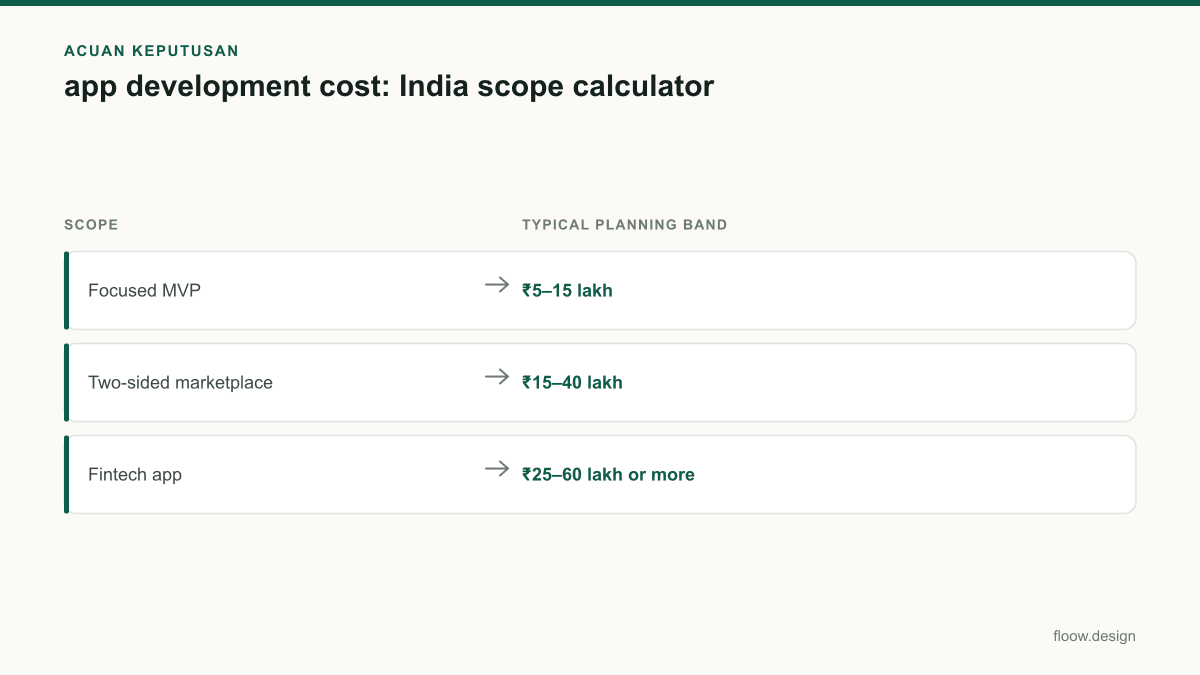
For early commercial planning, use these indicative pre-GST bands: a focused MVP is often ₹5–15 lakh, a two-sided marketplace is commonly ₹15–40 lakh, and a fintech app with meaningful payment and verification requirements can begin around ₹25–60 lakh or more. These are scoping bands, not fixed market rates. Native versus cross-platform delivery, API readiness, design-system maturity, security review, release support and the number of exception paths all change the estimate.
Ask each supplier to price the same screen and flow list. Separate product discovery, mobile UI/UX, backend, quality assurance, deployment and post-launch support. This makes a low proposal that omits critical work visible before the project starts.
Price Indian payment, tax and identity flows as complete journeys
Indian product requirements often add scope at the edges of a transaction. A UPI checkout is not just a payment button: define payment initiation, pending status, success and failure confirmation, retry behaviour, cancelled journeys, order reconciliation and support messaging. The relevant UPI operating context is published by the National Payments Corporation of India at NPCI.
If the app issues GST invoices, scope invoice data capture, tax treatment rules supplied by the business, invoice generation, download or sharing, corrections and the customer’s invoice history. Do not ask a development team to infer accounting rules from a mockup; provide the business’s tax and invoicing requirements. For domestic digital-service invoices, GST at 18% may apply where applicable. Confirm whether quoted fees are exclusive or inclusive of GST and obtain invoice treatment from the supplier. The official tax authority is GST.
Aadhaar-related verification needs an explicit user journey and a permitted implementation route. Budget for consent language, identity-status screens, fallback handling, error messages and support escalation. Do not assume an Aadhaar number field equals verification; requirements depend on the service, provider and applicable UIDAI rules. Check current official guidance at UIDAI.
Use an app prototype to remove expensive ambiguity
An app prototype is most valuable when it proves the flows that development estimates routinely miss. In floow.design, map the smallest viable screen set and link the critical paths: registration, login or verification, main task completion, payment, confirmation, history and help. Add role-specific screens for a customer, seller, delivery partner, operator or reviewer only when that role is truly part of launch scope.
For an Indian marketplace, prototype supply onboarding, catalogue management, payout visibility, cancellation and dispute states alongside buyer checkout. For a fintech concept, show UPI hand-off or payment status, transaction history, failure recovery and any Aadhaar-related verification fallback. For GST invoicing, include the invoice detail and retrieval path rather than leaving it as a backend note.
Use floow.design to validate the screen count and critical flows before requesting Indian development proposals. Export or share the resulting UI flow, then ask each team to identify exclusions, third-party costs, assumptions and delivery phases. A supplier can still propose technical alternatives, but the app prototype gives every bidder the same customer-facing scope to estimate.
Compare proposals with a release-ready checklist
A useful proposal for app development cost in India should distinguish one-time build work from recurring services. Require a line item for mobile UI implementation, backend or API work, quality assurance, project management, store-release support and a defined warranty or support period. Ask which external services are excluded, including messaging, maps, analytics, cloud infrastructure, payment-provider charges and identity-verification providers.
Check whether the estimate covers Android alone or both Android and iOS, and whether it includes production-ready UI states rather than only happy-path screens. A cheap quote can be accurate for a prototype build but misleading for a public launch if it excludes test coverage, monitoring, operational tooling or payment failure handling.
For domestic supplier invoices, ask the vendor to show the service value and GST separately where applicable. GST at 18% can change the cash outlay even when it does not change the underlying development scope. Keep commercial comparison simple: match the same release scope, list exclusions in writing, and treat later phases—such as advanced analytics, referral programmes, multilingual content or automation—as separately priced work.
Indicative India planning bands for mobile app delivery, before GST and third-party service charges
| Scope | Typical planning band | What should be defined before quoting |
|---|---|---|
| Focused MVP | ₹5–15 lakh | Core user journey, screen count, platform choice, API readiness and launch exclusions |
| Two-sided marketplace | ₹15–40 lakh | Buyer and seller roles, catalogue, checkout, operations, cancellations and payouts |
| Fintech app | ₹25–60 lakh or more | UPI/payment states, transaction records, verification journeys, security requirements and support handling |
Common mistakes
Requesting a quote for “an app like” a well-known product.
Describe the launch release: user roles, individual mobile screens, integrations, operational tasks and excluded features.
Treating UPI as one checkout screen.
Scope initiation, pending, completed, failed, cancelled, retry and reconciliation-related customer states.
Leaving GST invoicing for the backend phase.
Include invoice creation, invoice detail, retrieval, corrections and customer-facing support states in the release scope.
Assuming Aadhaar-related verification is a simple form field.
Define the approved verification route, consent copy, status states, failures and human-support fallback before estimation.
Frequently asked questions
How much does app development cost in India?
App development cost in India commonly plans around ₹5–15 lakh for a focused MVP, ₹15–40 lakh for a two-sided marketplace, and ₹25–60 lakh or more for fintech work with payment and verification complexity. These are indicative pre-GST planning bands; the actual proposal depends on screen count, platforms, integrations, testing and operational requirements.
What features make an Indian app more expensive to build?
In India, UPI payment journeys, GST invoice handling and Aadhaar-related verification can increase app scope because each requires customer-facing status, error, retry and support flows. Marketplace roles, payouts, cancellations, Android and iOS delivery, backend integrations, admin tools and production testing also raise the build effort beyond a basic mobile UI.
Can a prototype reduce app development cost?
An app prototype can reduce app development cost by exposing unnecessary screens, missing states and unclear ownership before engineering begins. In India, prototype UPI outcomes, GST invoice retrieval and Aadhaar-related verification fallbacks alongside the main journey. This lets development teams quote the same defined scope and prevents expensive changes during implementation.
Should GST be included in an Indian app development proposal?
An Indian app development proposal should clearly state whether GST is included or excluded. Domestic digital-service invoices may attract GST at 18% where applicable, so request the service value, GST amount and total payable separately. Confirm the supplier’s invoice treatment with the supplier and the business’s tax adviser before approving the budget.
Where this leaves you
Do not buy a generic estimate. Build a release-level mobile UI scope, validate it in floow.design, and compare Indian proposals against the same screens, critical flows, exclusions and applicable GST treatment.
Design the screens first
Describe the app in plain language and floow.design draws the iOS and Android screens for you, ready to refine and hand off.
Sources
- •Goods and Services Tax Network — official GST portal
- •National Payments Corporation of India — UPI information
Related reading
Design your mobile app with AI.
Generate pixel-perfect iOS and Android screens in seconds, then export to Figma or code.
You might also like…
 Insights20 September 2026mobile app development cost in india by app typeEstimate Indian mobile app budgets for commerce, delivery, travel and fintech, including UPI flows, Android-first scope and UI complexity.By floow.design Team, Mobile Design
 Insights20 September 2026app development cost in india: UI budget guideEstimate Indian app UI, flow and build costs in INR, account for 18% GST, and define localisation scope before requesting agency quotes.By floow.design Team, Mobile Design
 How-to20 September 2026ui ux design process for Indian mobile appsA practical ui ux design process for Indian mobile apps: research across languages and city tiers, design UPI and OTP flows, and plan consent.By floow.design Team, Mobile Design