
ui ux design course fees in India: compare costs
Compare Indian UI/UX course fees, GST on invoices, curriculum depth, mentorship, placement claims and portfolio value before enrolling.

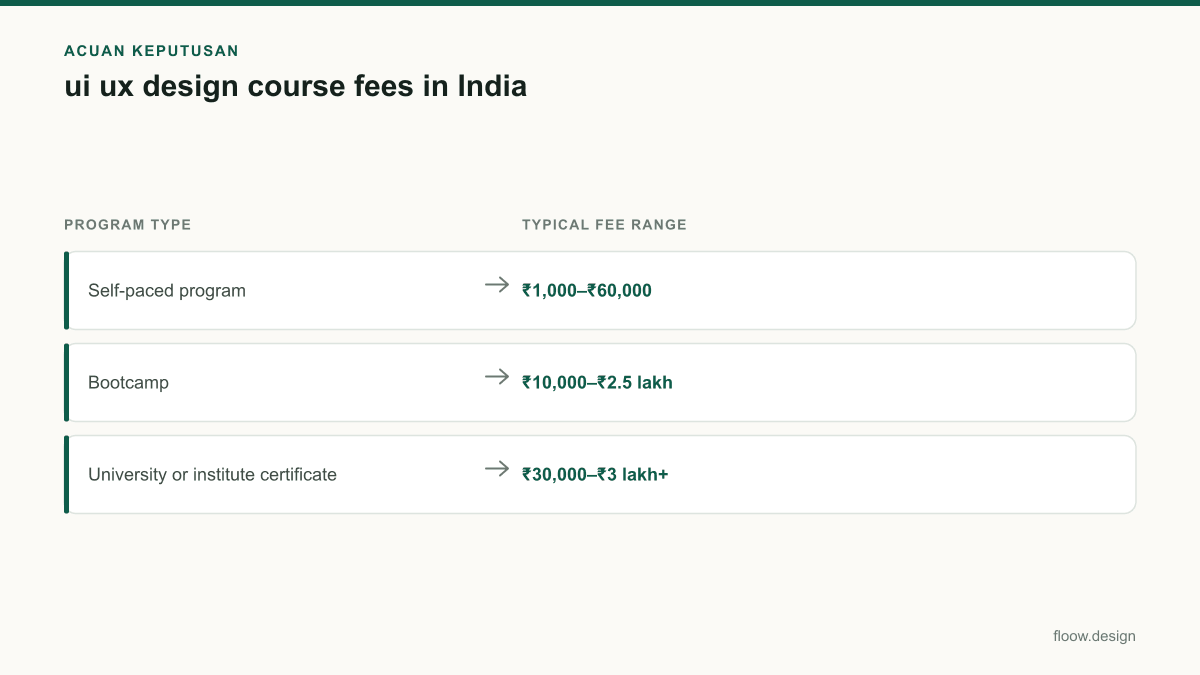
ui ux design course fees in India commonly range from about ₹1,000–₹60,000 for self-paced learning, ₹10,000–₹2.5 lakh for bootcamps, and ₹30,000–₹3 lakh or more for university certificates. Compare the final invoice, including GST where charged, with live-project feedback, mentor access, portfolio reviews and transparent placement outcomes.
Key takeaways
- •A low course fee can be good value when the curriculum includes structured critique and portfolio work, not only recorded lessons.
- •Ask whether the displayed price includes GST; the payable amount can differ from the advertised tuition when tax is charged.
- •Treat placement as an outcome to verify, not a promise: compare disclosed offers with typical Indian UI/UX fresher pay of roughly ₹3–₹6 lakh per annum, rather than overseas salary examples.
- •Use floow.design alongside coursework to create and improve more mobile-screen portfolio iterations than tutorial exercises alone.
What's on this page
- •What Indian learners usually pay
- •Match the fee to the curriculum, not the course title
- •Check placement claims against Indian entry-level pay
- •A practical buying checklist before payment
What Indian learners usually pay
Indian pricing splits into three practical brackets. Self-paced programs are usually around ₹1,000–₹60,000. They suit learners who can plan their own practice and obtain critique elsewhere, but check whether the fee buys permanent access, a subscription, or only a limited access period.
Bootcamps commonly sit around ₹10,000–₹2.5 lakh. The higher end should earn its price through scheduled mentor reviews, realistic mobile-app briefs, research practice, career support and a clear portfolio-review process—not a larger video library.
University or institute certificates often start near ₹30,000 and can exceed ₹3 lakh, depending on the institution, duration and live teaching format. A certificate may matter to some employers, but it does not replace demonstrable screens, flows and case studies.
Compare the all-in amount at checkout. Where a training provider charges GST, the tax should appear on the invoice with the supplier’s GST details and tax breakup. Do not assume a headline tuition figure is the final INR amount. The Central Board of Indirect Taxes and Customs publishes GST information at cbic-gst.gov.in.
Match the fee to the curriculum, not the course title
To judge how to become ui ux designer through a paid course, inspect the work you will actually produce. A useful curriculum moves from problem framing and user research to information architecture, user flows, wireframes, visual hierarchy, interaction states, usability testing and handoff. For Indian product roles, it should also make you design practical mobile patterns: multilingual content, low-bandwidth states, permissions, error recovery, Indian addresses and payment or delivery journeys when relevant.
Ask for the number of individual critiques, not merely the number of classes. Group webinars and recorded feedback are not equivalent to a mentor identifying why your flow fails, asking for alternatives and reviewing the revision. Also ask whether you keep ownership of the final case studies and whether reviewers assess the process, not just polished Figma frames.
The core ui ux designer skills employers can inspect are research synthesis, task-flow thinking, hierarchy, accessible interaction design, prototyping, writing clear UI copy and explaining decisions. Price is easier to justify when the course repeatedly tests those skills on different briefs. Use floow.design beside the course to generate extra mobile-app screen directions, then revise and document the strongest options in your portfolio.
Check placement claims against Indian entry-level pay
A placement percentage alone is weak evidence. Ask what counts as placement: a full-time UI/UX or product-design role, a paid internship, a contract assignment, or any job after course completion. Request the cohort size, number placed, reporting period, employers, role titles, locations and the salary range for offers accepted. If those details are unavailable, treat placement support as CV help and interview preparation, not a buying guarantee.
For a broad Indian reality check, UI/UX fresher packages are often discussed in the roughly ₹3–₹6 lakh per annum range, with substantial differences by city, company type, prior experience and portfolio quality. A course claiming a quick payback should be assessed against this local band and the time needed to secure a role—not against a US or European salary screenshot.
Calculate the fee as a share of a cautious first-year salary scenario. Then ask whether the program creates enough evidence to compete: two or three deep mobile case studies, documented iterations, prototype links and an explanation of research and trade-offs. The National Career Service is an official Indian employment portal for exploring jobs and career information: ncs.gov.in.
A practical buying checklist before payment
Before paying, download or save the syllabus and ask these questions in writing:
- •Is the advertised INR fee inclusive of GST, or will GST be added at payment?
- •How many one-to-one portfolio or design critiques are included?
- •Who are the mentors, and are their current product-design roles verifiable?
- •Are projects individual, or will the same template case study appear across the cohort?
- •What are the refund, deferral and access-duration terms?
- •Is placement described as assistance, interviews, internships or an actual guarantee?
For self-paced learning, reserve budget for critique or peer review; otherwise polished tutorial replicas can become the whole portfolio. For a bootcamp or university certificate, ask to see anonymised student portfolios from recent cohorts and compare their starting and final work. A strong final case study shows the mobile problem, audience, constraints, discarded options, tested flow and final rationale. It should not be a gallery of screens.
If your goal is product-design interviews, build beyond the assigned brief. Create alternate onboarding, empty, loading, permission and error states in floow.design, then select only the iterations that support a clear case-study story.
Indicative UI/UX learning fee brackets in India; verify the final invoice and inclusions before payment.
| Program type | Typical fee range | What should justify the cost |
|---|---|---|
| Self-paced program | ₹1,000–₹60,000 | Structured curriculum, updates, exercises and a clear access period |
| Bootcamp | ₹10,000–₹2.5 lakh | Live critique, mentor access, portfolio reviews and transparent career support |
| University or institute certificate | ₹30,000–₹3 lakh+ | Recognised instruction, assessed work, live teaching and relevant project feedback |
Common mistakes
Comparing only the advertised tuition fee.
Compare the final payable INR invoice, including GST where charged, payment-plan charges if any, access duration and the cost of separate mentorship.
Paying for a placement percentage without definitions.
Ask for the cohort denominator, role type, salary range, reporting period and whether internships or non-design roles are included.
Using overseas salary posts to justify an expensive course.
Model affordability against a cautious Indian UI/UX fresher range of roughly ₹3–₹6 lakh per annum and your likely job-search timeline.
Building only the course’s assigned screens.
Use floow.design to explore additional mobile states and directions, then show the reasoning and revisions in your portfolio.
Frequently asked questions
What are ui ux design course fees in India?
ui ux design course fees in India are commonly about ₹1,000–₹60,000 for self-paced programs, ₹10,000–₹2.5 lakh for bootcamps, and ₹30,000–₹3 lakh or more for university or institute certificates. The final amount can be higher than the advertised tuition if a provider charges GST, so check the invoice before paying.
Is a UI UX course worth the fee in India?
A UI/UX course is worth the fee in India when it gives you repeated individual critique, portfolio-quality mobile projects, usable research and prototyping practice, and clear terms on career support. Judge the cost against a cautious UI/UX fresher salary range of roughly ₹3–₹6 lakh per annum, not against overseas salary claims.
Do UI UX courses guarantee placement?
UI/UX courses do not automatically guarantee placement in India unless the provider states a specific written guarantee and its conditions. A placement percentage may include internships, contracts or non-design jobs. Ask for cohort size, roles obtained, employers, salary ranges, eligibility rules and the date range before treating placement support as a material reason to pay.
Should I pay extra for mentorship in a UI/UX course?
Paying extra for mentorship can be worthwhile when it includes scheduled one-to-one reviews, actionable feedback on revised work and portfolio guidance from practising designers. Ask how many reviews are included and whether mentors comment on user flows, states and rationale. Generic webinars or community access alone rarely justify a large premium.
Where this leaves you
Choose the lowest-priced path that still gives you accountable feedback and enough original mobile-app work to prove your decisions. Confirm the GST-inclusive invoice, interrogate placement evidence against Indian fresher pay, and use floow.design to create the additional iterations that make a portfolio more credible than course exercises alone.
Design the screens first
Describe the app in plain language and floow.design draws the iOS and Android screens for you, ready to refine and hand off.
Sources
Design your mobile app with AI.
Generate pixel-perfect iOS and Android screens in seconds, then export to Figma or code.
You might also like…
 Insights20 September 2026how to become ui ux designer in IndiaA practical India roadmap for aspiring UI UX designers: choose a learning path, build mobile case studies, budget in INR and apply to local roles.By floow.design Team, Mobile Design
 Insights20 September 2026ui ux designer salary for freshers: India bandsIndia fresher UI/UX salary bands by employer type and hiring hub, with portfolio proof, paid internship routes and PPO guidance for entry-level roles.By floow.design Team, Mobile Design
 Insights20 September 2026ui ux developer salary in India: INR pay guideCompare UI UX developer pay in India with frontend and product design roles, coding skills, city hiring patterns and mobile-screen handoff steps.By floow.design Team, Mobile Design