
ui ux designer salary for freshers: India bands
India fresher UI/UX salary bands by employer type and hiring hub, with portfolio proof, paid internship routes and PPO guidance for entry-level roles.

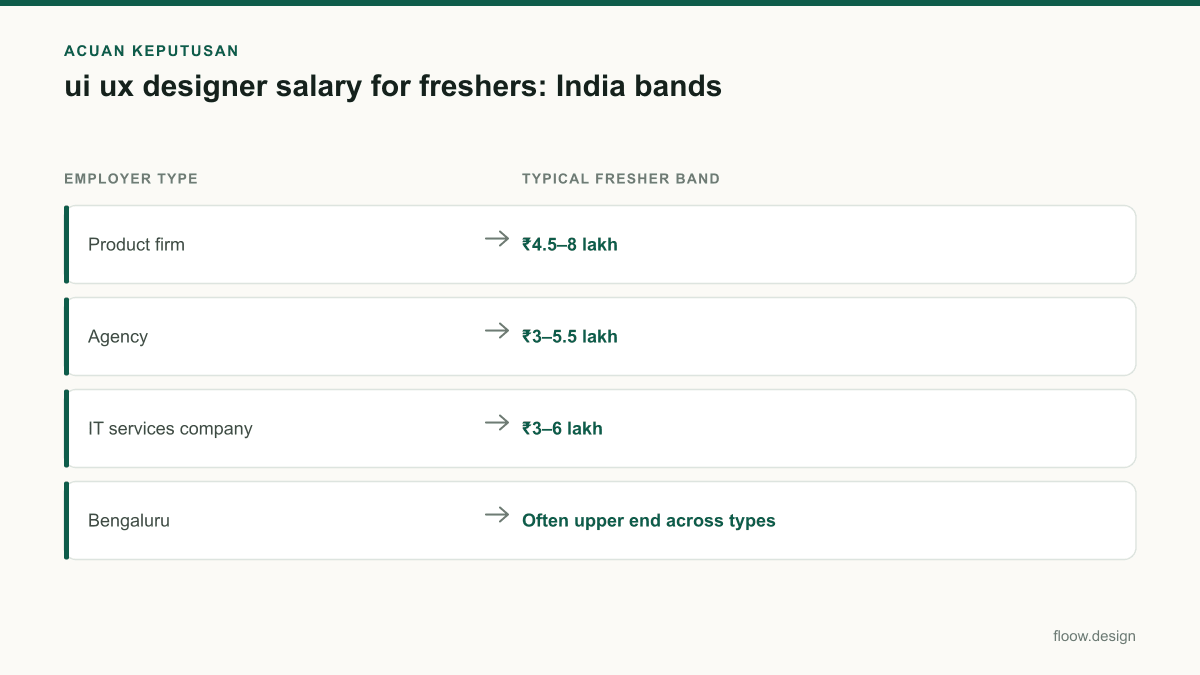
For a ui ux designer salary for freshers in India, plan around ₹3–5.5 lakh a year in agencies, ₹3–6 lakh in IT services and ₹4.5–8 lakh in product firms for 0–1 year roles. Bengaluru and NCR often sit toward the upper end, while a paid internship that converts to a PPO can improve a first offer.
Key takeaways
- •For 0–1 year roles, product firms usually offer the highest fresher bands; agencies can offer broader hands-on exposure; IT services can offer structured entry paths.
- •Compare annual CTC with fixed pay, variable pay, probation terms and the actual design scope before judging an offer.
- •A credible ui ux portfolio should show problem framing, screen decisions, prototype behaviour and validation—not only polished final screens.
- •Paid internships and PPOs are a common way into entry-level UI/UX work through Indian design schools and bootcamps.
What's on this page
- •India fresher salary bands by employer type and city
- •What employers want to see beyond ui ux designer skills
- •Paid internships and PPOs: the practical first-job route
- •How to negotiate a first UI/UX offer without overplaying experience
India fresher salary bands by employer type and city
For 0–1 year UI/UX roles, treat salary as an annual CTC planning band rather than a guaranteed market rate. Actual offers vary with the company’s funding, campus route, interview performance, fixed-versus-variable split and whether the role is design-heavy or mainly production UI work.
Product firms commonly fall around ₹4.5–8 lakh CTC for a fresher. Agencies are often around ₹3–5.5 lakh CTC, with quicker exposure to multiple clients and industries. IT services companies commonly land around ₹3–6 lakh CTC; the title may be UI/UX designer, visual designer, experience designer or a broader digital role.
Bengaluru generally has the strongest concentration of product-design openings and can support the upper end of these bands. NCR is similarly competitive for funded startups, consumer products and consulting. Pune and Hyderabad are active mid-range hubs with product, SaaS and services teams. Chennai has strong enterprise, SaaS and services demand, though fresher offers can be more conservative. Ask for the fixed annual amount, variable component, joining bonus, probation salary and work location before comparing two CTC figures.
The National Career Service is a useful official channel for checking how employers describe entry-level roles and skills in current listings (NCS).
What employers want to see beyond ui ux designer skills
Indian hiring teams do not expect a fresher to have shipped a large consumer app alone. They do expect evidence that you can turn an ambiguous brief into a usable mobile flow. The strongest ui ux designer skills signal is decision-making: why a user needs a feature, what information belongs on each screen, how errors are handled and how the flow works on a small Android screen.
Build two or three focused case studies instead of a gallery of disconnected Dribbble-style shots. For each project, show the brief, target user, task flow, early wireframes, final UI, prototype states and one round of feedback or usability checks. Include practical states that are often missing from fresher work: loading, empty, validation error, permission denial, offline or failed payment. If you use a familiar Indian context—UPI payment confirmation, address entry, delivery tracking or a multilingual onboarding choice—make the constraints explicit rather than adding them as decoration.
Use floow.design to create a credible first case-study flow: choose one mobile task, generate the key screens, then revise hierarchy, labels and edge states yourself. Export the screens and prototype, document the reasoning, and present it as a portfolio project for entry-level applications. For Android conventions, check the official Android developer guidance (Android Developers).
Paid internships and PPOs: the practical first-job route
A direct full-time application is not the only route to a first UI/UX role. Paid internships and PPOs—pre-placement offers after an internship—are common entry routes at Indian design schools and bootcamps. They give employers a lower-risk way to assess how a candidate takes feedback, works with developers and finishes everyday interface tasks rather than only creating a portfolio concept.
When evaluating an internship, ask whether it is paid, how long it runs, who reviews design work, what tools the team uses and whether a PPO has been offered to previous cohorts. Do not treat a PPO as certain until the terms are written down. Ask for the expected conversion timeline, likely designation, fixed pay, variable pay and whether conversion depends on business headcount.
Apply with a short, targeted package: a one-page résumé, portfolio link, two case studies and a note naming the mobile product problem you would like to work on. For bootcamp candidates without campus placement support, combine alumni referrals with direct applications to agencies, small SaaS companies and services teams. The AICTE internship portal is an official place to monitor internship opportunities, alongside company career pages (AICTE Internship Portal).
How to negotiate a first UI/UX offer without overplaying experience
For a fresher, negotiation works best when it is specific and respectful. First confirm whether the quoted number is annual CTC or fixed pay. Then ask about variable pay, retention conditions, health cover, equipment, notice period, probation, hybrid expectations and the design team you will join. A ₹5 lakh CTC offer with a large variable component is not directly comparable with ₹5 lakh fixed pay.
If you have competing interviews, say so plainly without inventing an offer. If you do not have use on salary, ask whether the company can review compensation after probation or confirm a learning plan with ownership of a defined mobile flow. Agencies may offer lower starting pay but more portfolio material; product teams may offer deeper ownership but a narrower hiring bar. IT services can provide process exposure and scale, but check whether the role includes actual UX work rather than only visual production.
Your best use is a clear portfolio story: show one flow you designed, explain the trade-off you made, and demonstrate how you would hand it to engineering. That is more credible than claiming expert-level research, strategy or leadership before you have worked in a team.
Indicative annual CTC planning bands for 0–1 year UI/UX roles in India
| Employer type | Typical fresher band | Where the upper end is more likely |
|---|---|---|
| Product firm | ₹4.5–8 lakh | Bengaluru and NCR; strong portfolio and relevant internship |
| Agency | ₹3–5.5 lakh | Larger agency teams in Bengaluru, NCR, Pune or Hyderabad |
| IT services company | ₹3–6 lakh | Role-specific design hiring; portfolio and campus or internship route |
| Bengaluru | Often upper end across types | Product and startup concentration |
| NCR | Often upper end across types | Product, startup, consulting and enterprise teams |
| Pune, Hyderabad and Chennai | Commonly mid-range, with exceptions | Company type, fixed pay and role scope matter more than city alone |
Common mistakes
Comparing only headline CTC figures.
Compare fixed annual pay, variable pay, joining or retention conditions, probation pay and benefits line by line.
Submitting a ui ux portfolio made only of final high-fidelity screens.
Show the user task, flow, wireframes, interaction states, decisions and one feedback or test iteration.
Applying only to jobs titled “UI/UX Designer.”
Also search for product designer, UX designer, interaction designer, visual designer and experience designer roles, then inspect the actual responsibilities.
Treating an internship PPO as automatic.
Ask whether conversion is written into the offer, when the decision is made and what salary and headcount conditions apply.
Frequently asked questions
What is a good UI UX designer salary for freshers in India?
A good UI/UX designer fresher offer in India is commonly around ₹4.5–8 lakh annual CTC at a product firm, ₹3–5.5 lakh at an agency and ₹3–6 lakh at an IT services company for 0–1 year roles. Bengaluru and NCR can reach the upper end, but fixed pay, variable pay and role scope matter more than CTC alone.
Can a fresher get a UI UX job without a design degree?
A fresher can get a UI/UX job in India without a design degree if the portfolio demonstrates mobile problem-solving, interface hierarchy, interaction states and clear reasoning. A paid internship, bootcamp project, freelance work or self-directed case study can provide evidence. Employers will usually value a well-explained project over an unsupported certificate list.
What should a fresher UI UX portfolio include?
A fresher UI/UX portfolio should include two or three mobile case studies with the problem, intended user, task flow, wireframes, final screens, prototype and edge states such as empty, loading and error conditions. Each project should explain key decisions and feedback. A floow.design-generated flow can become a credible project when you revise it and document your own rationale.
Are paid UI/UX internships useful for getting a PPO in India?
Paid UI/UX internships are useful entry routes in India because they let a company assess day-to-day design work before making a pre-placement offer, or PPO. Before accepting, confirm the stipend, duration, mentor, design responsibilities, conversion criteria and expected full-time compensation. A PPO should not be assumed unless its conditions are communicated in writing.
Where this leaves you
Use the salary band as a comparison tool, not a promise. Build one thoughtful mobile case study with floow.design, add your reasoning and edge states, then use it to apply for internships, PPO tracks and entry-level UI/UX roles across India’s hiring hubs.
Design the screens first
Describe the app in plain language and floow.design draws the iOS and Android screens for you, ready to refine and hand off.
Sources
Related reading
Design your mobile app with AI.
Generate pixel-perfect iOS and Android screens in seconds, then export to Figma or code.
You might also like…
 Insights20 September 2026ui ux designer salary per month: India guideCompare monthly gross and likely in-hand pay for UI/UX roles in India, including CTC, basic pay, employee PF and salary-negotiation checks today.By floow.design Team, Mobile Design
 Insights20 September 2026ui ux developer salary in India: INR pay guideCompare UI UX developer pay in India with frontend and product design roles, coding skills, city hiring patterns and mobile-screen handoff steps.By floow.design Team, Mobile Design
 Insights20 September 2026Senior ux designer salary in India: pay bandsBenchmark senior UX pay in India across startups, GCCs and IT services, and see how ownership, domain depth, leadership and ESOPs affect offers.By floow.design Team, Mobile Design