
how to become ui ux designer in India
A practical India roadmap for aspiring UI UX designers: choose a learning path, build mobile case studies, budget in INR and apply to local roles.

To learn how to become ui ux designer in India, build mobile-first fundamentals, turn them into two case studies, and apply through Naukri, Cutshort and Instahyre. You can enter through an Indian college, a bootcamp, an internship or a self-taught portfolio; judge each route against its INR cost, your timeline and the fresher roles available in your target city.
Key takeaways
- •Start with one complete mobile app flow, not isolated login screens or dashboard shots.
- •Choose college, bootcamp, internship or self-taught learning based on time, budget in INR and portfolio output.
- •Treat fresher compensation as annual CTC in INR and compare course fees with realistic job-search timing.
- •Use Naukri, Cutshort and Instahyre after your portfolio has clear mobile case studies and a concise profile.
What's on this page
- •Choose the Indian pathway that fits your starting point
- •Build foundations around real mobile app decisions
- •Plan your ui ux portfolio before you finish learning
- •Set INR milestones for courses, compensation and the job search
- •Apply through India-focused platforms and improve from feedback
Choose the Indian pathway that fits your starting point
There is no single entry route into UI/UX work in India. A college route can suit students who want structured design, HCI or product exposure alongside a recognised qualification. When comparing programmes, check the curriculum for interaction design, research, prototyping and mobile product work—not only visual communication. The Ministry of Education’s AISHE data is useful for identifying the wider higher-education landscape, but evaluate each institution’s current course page and student work yourself.
A bootcamp is useful when you need deadlines, feedback and placement preparation. Ask for the exact number of portfolio projects, mentor access, refund terms and the names of hiring partners before paying. A self-taught route costs less in tuition but demands a weekly practice plan and peer critique. Internships can bridge either route: apply to product companies, agencies and early-stage teams once you can explain one mobile flow end to end. Do not wait for a certificate before building evidence of your process.
Build foundations around real mobile app decisions
Learn UI and UX together, but do not confuse them. UX means understanding a user task, mapping the flow, testing assumptions and reducing friction. UI means making the resulting screens readable, consistent and usable: type hierarchy, spacing, colour, components, states and accessibility.
Use a practical sequence: study a familiar Android or iOS app, identify one task such as booking an appointment or tracking a delivery, draw the existing flow, then redesign one failure point. Learn Figma well enough to create components, variants, auto layout and clickable prototypes. For platform patterns, use the official Material Design guidance and Android Developers documentation rather than copying trendy Dribbble shots.
Start the portfolio stage early by creating your first complete mobile app flow in floow.design. Include entry, empty, loading, error, success and return states. That scope proves more than a polished home screen because Indian interviewers can see how you handle the decisions users encounter after the first tap.
Plan your ui ux portfolio before you finish learning
A credible ui ux portfolio for Indian entry-level roles needs two strong mobile case studies before it needs six decorative concepts. Pick problems you can research honestly: a hostel visitor process, a clinic follow-up journey, a local retailer’s repeat-order flow or a student expense tracker. Avoid claiming that you interviewed users if you only guessed their needs.
For each case study, show the problem, target user, assumptions, task flow, low-fidelity exploration, final screens and what changed after feedback. Add a short prototype link or video, but make the written narrative understandable without opening it. Explain trade-offs: why a payment option appears at a specific point, why a field is optional, or how an error state helps recovery.
Keep projects mobile-first. If you redesign a payments or identity-related journey, label it as a concept and do not imply approval by a bank, UPI participant or regulator. Use your own content or clearly marked placeholders. Recruiters should be able to scan the first screen of the case study and understand the user problem, your role and the outcome.
Set INR milestones for courses, compensation and the job search
Treat learning as an investment plan, not a purchase of a certificate. UI UX design course fees in India vary widely by format: self-directed learning may mainly require time and software access, while live bootcamps and longer college programmes can require a much larger INR commitment. Before enrolling, write down the total payable INR amount, financing terms, portfolio deliverables, mentor time and whether placement support is a promise or merely job-board access.
Set compensation milestones in annual INR CTC, because that is how many Indian fresher offers are presented. Save actual listings in your target city and role type, then compare the offered CTC with the course’s full INR cost and the months you can fund while searching. Do not assume every advertised CTC becomes take-home pay; ask about fixed pay, variable pay, probation and location requirements.
Your first milestone is not a salary number. It is a portfolio ready for review. The next is ten tailored applications per week, followed by interview practice: explain a flow, critique a screen and complete a timed mobile exercise. The Government of India’s National Career Service can complement company job pages during the search.
Apply through India-focused platforms and improve from feedback
Build a one-page resume that links directly to your portfolio and names the work accurately: “UX case study,” “mobile prototype” or “interaction design project,” rather than “shipped product” if it was not launched. Put tools below outcomes. A recruiter cares more that you simplified an onboarding flow after testing than that you list every design application.
Search Naukri, Cutshort and Instahyre for UI designer, UX designer, product designer, interaction designer and design intern roles. Read descriptions for recurring requirements, then close one gap at a time. If roles repeatedly ask for design systems, add component documentation to a case study. If they ask for research, run a small usability session and document the findings.
Tailor applications by company type. Agencies may value range and speed; product teams often inspect product thinking and collaboration. For every rejection or non-response, review the first 30 seconds of your portfolio: can someone immediately see a mobile problem, your process and the final outcome? Keep applying while you improve rather than pausing the search until everything feels perfect.
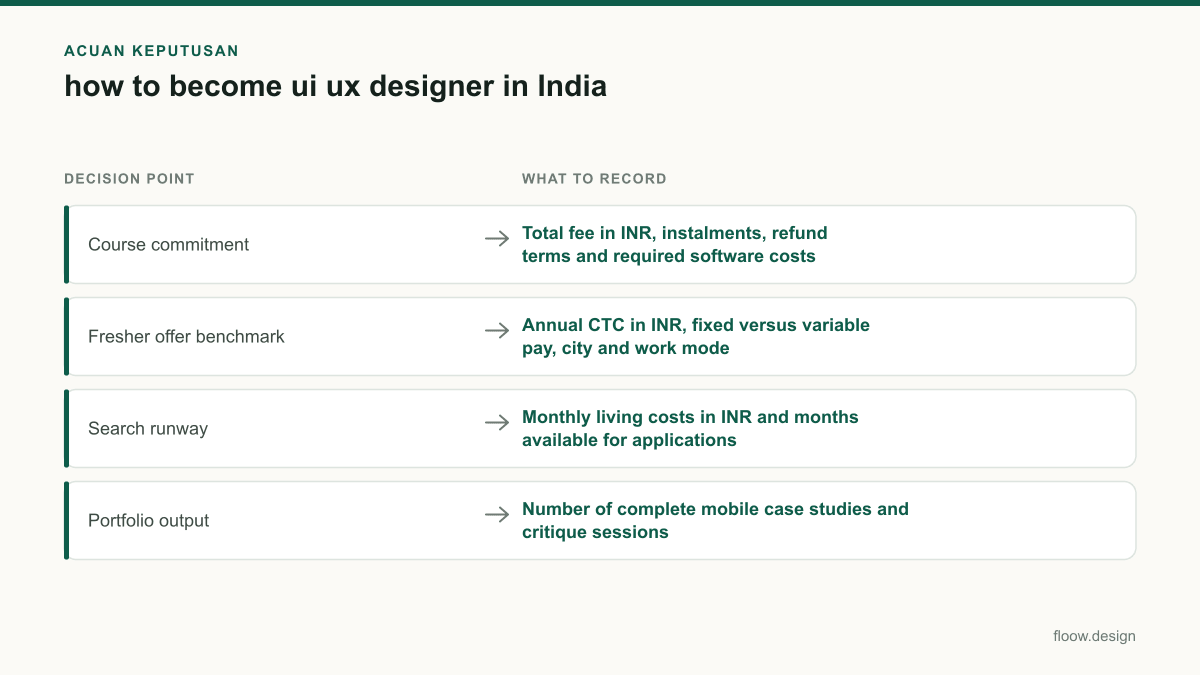
INR decision checklist before choosing a UI/UX learning route
| Decision point | What to record | Why it matters |
|---|---|---|
| Course commitment | Total fee in INR, instalments, refund terms and required software costs | Prevents comparing a headline fee with the real amount payable. |
| Fresher offer benchmark | Annual CTC in INR, fixed versus variable pay, city and work mode | Lets you assess an offer and estimate whether course spending is proportionate. |
| Search runway | Monthly living costs in INR and months available for applications | Keeps the transition plan realistic while you build projects and interview. |
| Portfolio output | Number of complete mobile case studies and critique sessions | Measures a course or self-taught plan by hiring evidence, not certificate length. |
Common mistakes
Paying for a course because it promises placement without checking the actual portfolio work required.
Compare total INR fees, mentor access, project depth, refund terms and the type of roles past learners can publicly demonstrate.
Publishing only high-fidelity screens.
Show the user task, flow, rejected options, states and feedback that led to the final mobile interface.
Applying for every design title with the same resume and portfolio order.
Match the first case study and resume language to the role, such as product design, UX research support or UI-heavy mobile work.
Using annual CTC as if it were monthly take-home pay.
Ask employers which part is fixed, which is variable, and whether probation or location changes the compensation structure.
Frequently asked questions
How can I become a ui ux designer in India?
To become a UI UX designer in India, learn mobile interaction design, visual hierarchy, prototyping and basic user research, then create two complete case studies. You can learn through an Indian college, bootcamp, internship or self-taught plan. Publish a portfolio, tailor applications, and search UI/UX, product design and internship roles on Naukri, Cutshort and Instahyre.
Do I need a degree to become a UI UX designer?
You do not need a specific degree to become a UI UX designer in India, but a degree can provide structure, peers and internship access. Employers still need evidence that you can solve mobile product problems. A self-taught or bootcamp candidate should compensate with strong case studies, clear process documentation, practical prototypes and feedback from real users or reviewers.
How long does it take to get a UI UX job in India?
Getting a UI UX job in India can take several months of focused learning and portfolio building, followed by an unpredictable application period. The timeline depends on your prior visual-design or product experience, the quality of two mobile case studies, interview practice, target city and role level. Begin applying once your portfolio explains complete flows, not only polished screens.
What should I include in a UI UX portfolio for Indian fresher roles?
A UI UX portfolio for Indian fresher roles should include two complete mobile case studies with the problem, target user, task flow, wireframes, final UI, prototype and lessons from feedback. Show loading, empty, error and success states where relevant. Make your role explicit and avoid claiming launch results, user research or business impact that you cannot verify.
Where this leaves you
The fastest credible route is to learn the fundamentals while producing visible mobile work. Build your first complete flow in floow.design, turn it into a documented case study, set a realistic INR learning and job-search budget, and apply consistently to India-focused opportunities.
Design the screens first
Describe the app in plain language and floow.design draws the iOS and Android screens for you, ready to refine and hand off.
Sources
- •All India Survey on Higher Education, Ministry of Education
- •National Career Service, Ministry of Labour and Employment
- •Material Design
- •Android Developers
- •Naukri
Related reading
Design your mobile app with AI.
Generate pixel-perfect iOS and Android screens in seconds, then export to Figma or code.
You might also like…
 Insights20 September 2026ui ux portfolio for India product jobsBuild a ui ux portfolio for India product jobs with mobile case studies for UPI, COD, OTP and multilingual onboarding, tailored to recruiters.By floow.design Team, Mobile Design
 Insights20 September 2026ui ux designer jobs in India: application guideFind UI/UX roles in India through the right channels, tailor your portfolio for local hiring, and compare CTC offers with global contract work.By floow.design Team, Mobile Design
 Insights20 September 2026ui ux design course fees in India: compare costsCompare Indian UI/UX course fees, GST on invoices, curriculum depth, mentorship, placement claims and portfolio value before enrolling.By floow.design Team, Mobile Design