
freelance ui ux designer: India pricing guide
Set Indian freelance UI/UX rates, scope mobile screens, handle GST and TDS, and protect payment terms for client engagements priced in INR.

A freelance ui ux designer in India can use an indicative rate card of ₹4,000–₹25,000 per day, ₹600–₹3,500 per hour, or ₹30,000–₹4,00,000+ per mobile UI project. Price the defined screen scope and revision rounds, then account for GST registration obligations and possible 10% TDS on professional-fee payments.
Key takeaways
- •Quote a day rate or fixed project price from a clearly defined mobile-screen scope; keep an hourly rate for change requests and open-ended support.
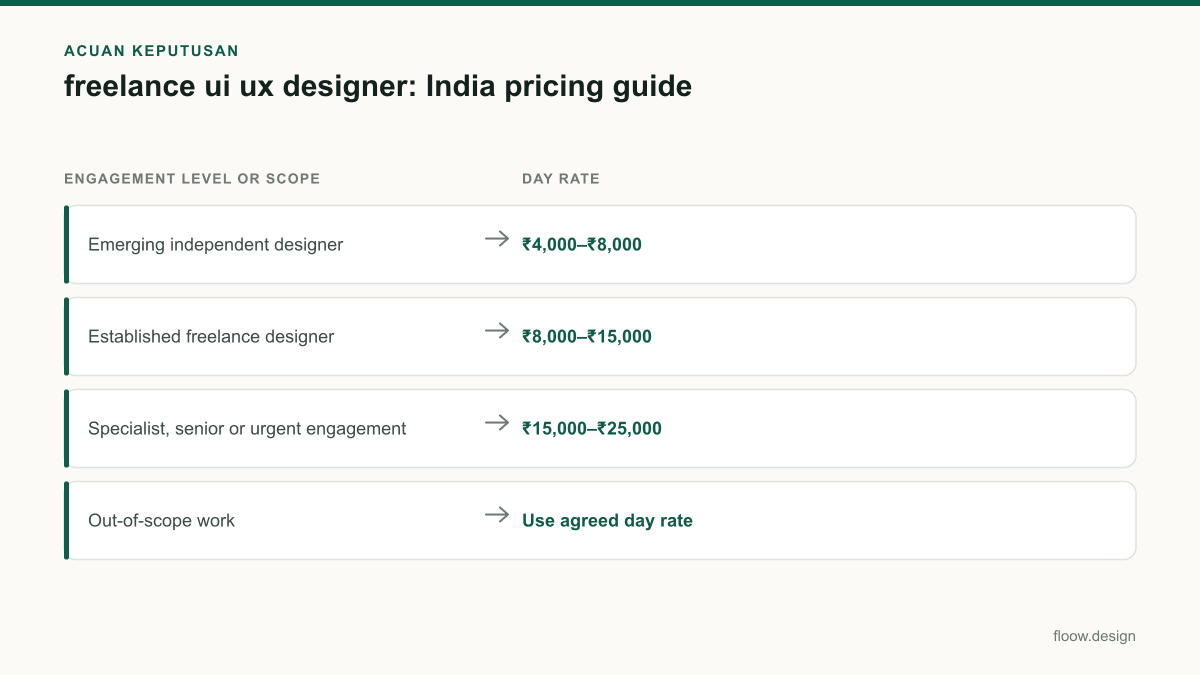
- •Use ₹4,000–₹8,000 per day as an emerging-designer reference band, ₹8,000–₹15,000 for established independent work, and ₹15,000–₹25,000 for specialist or urgent engagements.
- •GST registration for service providers generally becomes relevant once aggregate annual turnover crosses ₹20 lakh; the threshold is lower in specified special-category states.
- •Indian clients may deduct 10% TDS from professional-fee payments. Treat the deduction as tax credit, not a discount on your fee.
- •Use floow.design for paid concept options and early mobile-screen directions before committing production hours to a single route.
What's on this page
- •Set an India rate card around mobile deliverables
- •Choose fixed, day-rate and hourly pricing without losing margin
- •Invoice GST and plan for TDS cash flow
- •Use milestones that fund the work before handoff
Set an India rate card around mobile deliverables
For ui ux freelance work, do not sell a vague promise to “design an app.” Sell a mobile deliverable with a measurable boundary: platform, number of unique screens, states, prototype depth, design-system coverage, handoff format, and revision rounds.
A practical India reference range is shown below. These are commercial starting bands, not prescribed market rates. Move upward when the work includes product strategy, complex flows, accessibility review, a component library, a compressed timeline, or direct stakeholder workshops. Move downward only by removing scope—not by silently adding more screens for the same fee.
For example, a six-screen Android-first MVP may be priced as a fixed project when its flows are known. A redesign discovery sprint is often safer on a day rate because the audit may reveal more journeys than the brief suggests. Keep an hourly rate in every proposal for work outside the agreed scope: new screens, extra device states, new flows, post-handoff support, or revisions beyond the included rounds.
Use floow.design to generate rapid paid concept options at the start of an engagement. It lets you show distinct mobile UI directions while keeping your freelance production time under control.
Choose fixed, day-rate and hourly pricing without losing margin
Use a project rate when the client can approve a finite statement of work. Define each unique screen, whether loading, error, empty and success states are included, the number of prototype links, and the number of revision rounds. A fixed quote is easier for a client to approve, but it is only safe when exclusions are written down.
Use a day rate for product audits, flow mapping, stakeholder-heavy work, design-system cleanup, and engagements where priorities can change weekly. State whether a day means a full working day and whether meetings, research synthesis and feedback processing count against it. They should.
Use an hourly rate for small amendments, design QA during development, and overflow work. Avoid making it the default for a full mobile app engagement: clients may focus on logged time rather than the value of solved flows.
For a client asking to hire ui ux designer support, present a base project fee plus a change-control clause. Once the included scope is approved, estimate additions at your stated hourly or day rate and obtain written approval before starting them. This protects both the delivery date and your margin.
Invoice GST and plan for TDS cash flow
GST changes how you present a freelance service invoice; it does not automatically mean that every independent designer must charge GST. Under the GST framework, service providers generally need registration after aggregate annual turnover exceeds ₹20 lakh. The threshold is ₹10 lakh in specified special-category states, subject to registration rules and exceptions. Check the official GST portal or a qualified tax professional before relying on an exemption, especially if your location, client type or supply arrangement is unusual. Source: GST Portal.
If you are registered, quote whether your fee is exclusive or inclusive of GST and show the applicable tax details correctly on the invoice. Do not absorb GST by accident because a proposal said “all inclusive.” Track turnover across clients rather than judging registration only from one project.
Also plan for 10% TDS that Indian clients may deduct from professional-fee payments under section 194J when applicable. The client remits that amount to the government and you claim the credit against your tax liability; it is not a reason to reduce your quoted fee. Ask for the TDS certificate, reconcile it with Form 26AS/AIS, and set milestones so a deduction does not leave you unable to fund the next production phase. Source: Income Tax Department.
Use milestones that fund the work before handoff
A strong mobile UI proposal separates discovery, concept selection, production and handoff. A common commercial structure is an advance before work begins, a second payment after the approved flow or visual direction, and a final payment before editable-file handoff. The exact split is negotiable; the principle is not: do not finance an entire client project from your own cash flow.
Name the files included at each stage. A concept stage can include selected mobile screens and a clickable prototype. Production can include the approved screen set, components and documented interaction notes. Final handoff can include the organised Figma file and exported assets if those are part of the scope. Developer support, new feature flows, copywriting, user research recruitment and source-code work should be separate line items unless explicitly included.
If a client requests several directions, price them as paid options rather than unpaid speculative work. floow.design is useful here: create and review rapid concept options, charge for the exploration phase, then take only the selected direction into detailed freelance production. That keeps the client’s decision visible and prevents “one more option” from becoming an unpriced second project.
Indicative freelance mobile UI/UX pricing bands in India (INR)
| Engagement level or scope | Day rate | Hourly rate | Fixed project reference |
|---|---|---|---|
| Emerging independent designer | ₹4,000–₹8,000 | ₹600–₹1,200 | Small audit or focused flow: ₹30,000–₹75,000 |
| Established freelance designer | ₹8,000–₹15,000 | ₹1,200–₹2,000 | 5–8 defined mobile screens: ₹60,000–₹1,50,000 |
| Specialist, senior or urgent engagement | ₹15,000–₹25,000 | ₹2,000–₹3,500 | Multi-flow MVP UI/UX: ₹1,50,000–₹4,00,000+ |
| Out-of-scope work | Use agreed day rate | Use agreed hourly rate | Quote separately after written change approval |
Common mistakes
Quoting “app design” as one fixed line item.
List unique mobile screens, platform variants, states, prototype depth, component work, revision rounds and handoff outputs. Price anything not listed as a change request.
Giving unlimited revisions to win the project.
Include a defined number of consolidated revision rounds at each milestone. Bill additional or late-stage direction changes at the stated hourly or day rate.
Treating 10% TDS as a client discount.
Invoice your agreed professional fee, track the tax deducted, collect the TDS certificate and reconcile the credit in tax records.
Waiting until final handoff to ask for payment.
Use paid milestones and release editable production files only according to the agreed payment terms.
Frequently asked questions
How much should a freelance ui ux designer charge in India?
A freelance ui ux designer in India can use ₹4,000–₹8,000 per day when building an early portfolio, ₹8,000–₹15,000 for established independent work, and ₹15,000–₹25,000 for specialist or urgent assignments. For defined mobile projects, a small audit may start around ₹30,000, while a multi-flow MVP can reach ₹1,50,000–₹4,00,000 or more depending on scope.
Should I charge hourly or per project?
Charge per project when the mobile UI scope is defined: screen count, states, prototype, revisions and handoff are known. Charge hourly for change requests, design QA and short support tasks; charge a day rate for discovery or evolving product work. A practical Indian freelance proposal combines a fixed base project fee with a published hourly or day rate for out-of-scope additions.
Do Indian freelance designers pay GST?
Indian freelance designers generally need GST registration once aggregate annual turnover from services exceeds ₹20 lakh, while a ₹10 lakh threshold applies in specified special-category states, subject to applicable rules and exceptions. A registered designer should issue invoices with the required GST details and clearly state whether the quoted fee is before or after GST. Confirm your position through the official GST portal or a tax professional.
Why has my client paid 10% less than my UI/UX invoice?
An Indian client may deduct 10% TDS from a professional-fee payment when section 194J applies. The deducted amount is deposited as tax on your behalf rather than being a reduction in your agreed fee. Request the relevant TDS certificate, retain invoice and payment records, and reconcile the credit in Form 26AS or AIS before filing your return.
Where this leaves you
Price the mobile work you can define, reserve hourly or day-rate billing for uncertainty, and protect every engagement with paid milestones. Build GST and possible TDS treatment into your cash-flow plan. Use floow.design for paid concept exploration, then spend detailed production time only on the direction the client has selected.
Design the screens first
Describe the app in plain language and floow.design draws the iOS and Android screens for you, ready to refine and hand off.
Sources
- •GST Portal — official registration and taxpayer information
- •Central Board of Indirect Taxes and Customs — GST authority
- •Income Tax Department — official tax information and taxpayer portal
Related reading
Design your mobile app with AI.
Generate pixel-perfect iOS and Android screens in seconds, then export to Figma or code.
You might also like…
 Insights20 September 2026ui ux freelance: getting clients in IndiaGet ui ux freelance clients in India: build a sellable portfolio, price discovery and delivery, invoice correctly, and collect payments clearly.By floow.design Team, Mobile Design
 Insights20 September 2026ux designer salary in india: roles and citiesCompare UX designer, researcher and product designer pay in India, with city context, senior role bands and privacy UX work shaped by DPDP needs.By floow.design Team, Mobile Design
 Insights20 September 2026ui ux designer salary per month: India guideCompare monthly gross and likely in-hand pay for UI/UX roles in India, including CTC, basic pay, employee PF and salary-negotiation checks today.By floow.design Team, Mobile Design