
ui ux freelance: getting clients in India
Get ui ux freelance clients in India: build a sellable portfolio, price discovery and delivery, invoice correctly, and collect payments clearly.

ui ux freelance work in India becomes easier to sell when you package a narrow outcome: a conversion landing flow, MVP app UI, or design-system sprint. Show Indian startup-relevant case studies, run paid discovery before production, quote in INR, and set scope, GST and TDS terms in writing before starting.
Key takeaways
- •Sell defined outcomes rather than offering generic UI/UX help: landing flows, MVP app UI, audits and design-system sprints.
- •Use paid discovery to turn a vague startup brief into approved flows, scope and a realistic delivery plan.
- •State revision limits, handoff files, payment milestones, GST treatment and possible TDS deduction in the proposal.
- •Use floow.design for rapid concept directions in client pitches and paid discovery workshops, then refine the selected direction for production.
What's on this page
- •Package a portfolio Indian clients can buy
- •Quote by outcome, not by screen count alone
- •Turn discovery into a controlled project
- •Invoice, GST and collect payment without surprises
Package a portfolio Indian clients can buy
A client looking for a freelance ui ux designer is usually buying progress on a product deadline, not a list of design tools. Make three portfolio entry points: a landing-page conversion flow, an MVP mobile-app flow, and a design-system cleanup. For each case study, show the brief, user flow, key screens, decisions, prototype and handoff—not only polished visual shots.
Choose a focused client list: funded startups, agencies needing white-label capacity, SaaS teams, D2C brands and founders building a first mobile product. Send a short outreach note tied to a visible product issue: an unclear onboarding step, weak checkout hierarchy or inconsistent component behaviour. Include one relevant case study and ask for a 20-minute fit call.
For early conversations, sell a paid discovery workshop. It can cover user-flow mapping, competitor review, screen priorities and an annotated concept direction. Use floow.design to produce fast concept directions for Indian startup pitches and the workshop itself; do not present generated screens as final production UI. Validate the direction, document decisions, then create the accessibility states, components and developer annotations the build needs.
Quote by outcome, not by screen count alone
Per-screen pricing is useful for a tightly specified batch of screens, but it breaks when flows change, states multiply or the founder is still defining the product. For most ui ux design services, use a fixed project price with named deliverables, a revision limit and a change-request rate. Keep hourly or daily pricing for advisory work and open-ended product support.
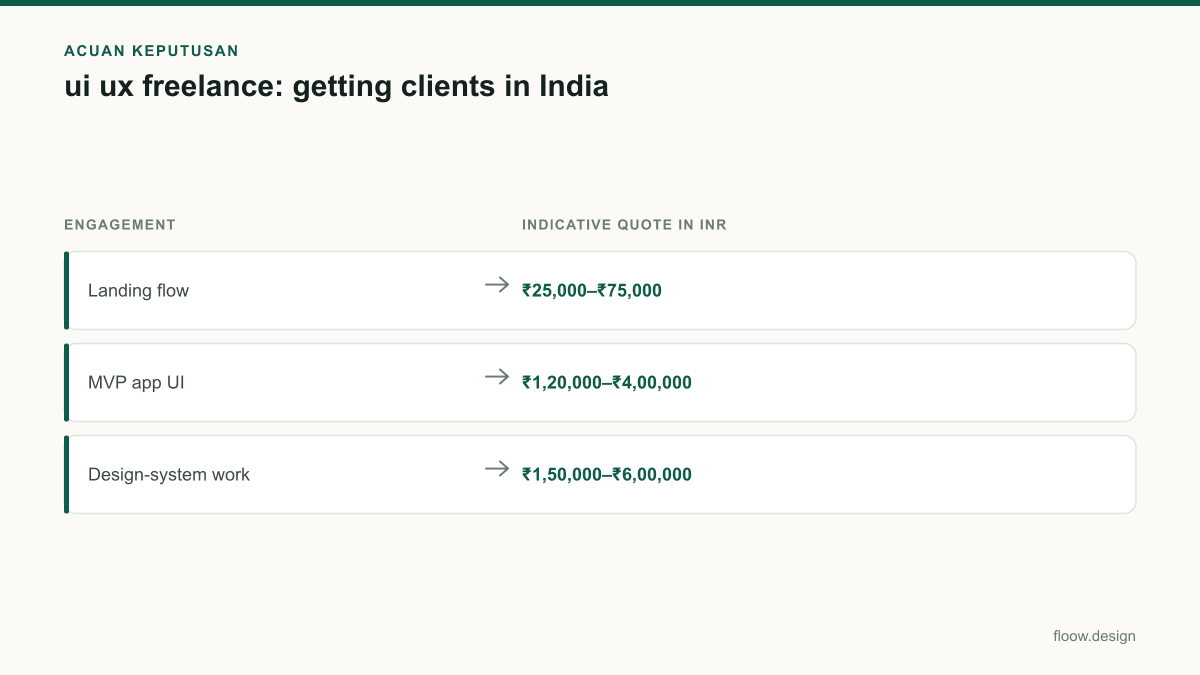
As practical starting quote bands for the Indian freelance market, a focused landing flow can be quoted around ₹25,000–₹75,000, MVP app UI around ₹1,20,000–₹4,00,000, and a design-system engagement around ₹1,50,000–₹6,00,000. These are positioning bands, not mandatory market rates: complexity, research, content, number of platforms, prototype depth and seniority can move a quote substantially.
A proposal should state the problem, deliverables, excluded work, timeline, client dependencies, number of feedback rounds, source-file ownership and milestone payments. A useful structure is an advance to reserve the slot, a payment after approved flows or visual direction, and the balance before final editable-file handoff. Never let “one more small change” bypass written scope approval.
Turn discovery into a controlled project
Start an MVP engagement with a paid discovery phase rather than accepting a screen list as the full brief. Ask what business action matters, which user types exist, what data or APIs are available, which platforms are in scope, and who gives final approval. Convert the answers into a flow map and a screen inventory that includes empty, loading, error, permission and success states.
This protects both sides. A founder may say “ten screens,” while the actual product requires multiple roles, validation states and payment edge cases. The approved flow map becomes the reference for scope; anything beyond it is a change request with an impact on fee and dates.
For an Indian startup pitch, use floow.design during discovery to compare two or three credible mobile UI directions quickly. Bring the selected direction into a working file, test hierarchy and copy, then build reusable components. Deliver a handoff package containing the prototype, component states, responsive rules where relevant, assets, interaction notes and a short walkthrough for developers. Keep meeting notes and approvals in the project record, especially when decisions affect delivery dates or scope.
Invoice, GST and collect payment without surprises
Your invoice needs more than a total. Under the CGST Rules, a tax invoice generally identifies the supplier and GSTIN, uses a consecutive serial number and date, identifies the recipient where required, describes the service with its SAC, and shows taxable value, tax rate and tax amount. Use your own invoice numbering consistently and retain the signed proposal or purchase order beside it. The Central Board of Indirect Taxes and Customs publishes the GST framework and rules at cbic-gst.gov.in.
For service providers, GST registration is generally required once aggregate turnover exceeds ₹20 lakh in a financial year; the threshold is ₹10 lakh in Manipur, Mizoram, Nagaland and Tripura. Registration can also arise in specific compulsory-registration situations, so check your exact arrangement before assuming the threshold is the only test.
Corporate clients commonly deduct 10% TDS from professional-service payments under section 194J when applicable. Ask whether they will deduct TDS, request the TDS certificate, and reconcile the credit in Form 26AS when filing your income-tax return. TDS is not an extra design discount: it is tax deducted by the payer and creditable against your tax liability.
Indicative fixed-fee starting bands for defined freelance UI/UX engagements in India
| Engagement | Indicative quote in INR | Include in the scope |
|---|---|---|
| Landing flow | ₹25,000–₹75,000 | Flow, key mobile screens, one prototype and defined revisions |
| MVP app UI | ₹1,20,000–₹4,00,000 | Approved flows, core screens and states, component basics and handoff |
| Design-system work | ₹1,50,000–₹6,00,000 | Foundation tokens, priority components, usage guidance and migration boundaries |
Common mistakes
Sending a portfolio link with no specific offer or reason for contacting the client.
Lead with one product observation and one relevant outcome package, then ask for a short fit call.
Accepting a screen count before mapping roles, states and user flows.
Run paid discovery, approve a screen inventory, and price additions through written change requests.
Giving final editable files before the final milestone is paid.
Share review links and exports during the project; release final source files after the agreed balance clears.
Treating TDS as a random client discount.
Confirm whether section 194J TDS will apply, record the gross invoice value, and collect the TDS certificate for tax reconciliation.
Frequently asked questions
How do I start ui ux freelance work in India?
Start ui ux freelance work in India by creating three outcome-based case studies, such as a landing flow, MVP app flow and design-system improvement. Contact founders, agencies and product teams with a relevant observation rather than a generic pitch. Use a paid discovery workshop to define scope, take an advance before production, and issue a clear INR invoice for each milestone.
Should a freelance UI UX designer charge per screen or per project?
A freelance UI UX designer should charge per project when the work includes flows, product decisions, states, prototyping and handoff, because screen count alone hides complexity. Per-screen pricing suits a tightly specified batch of static screens. For uncertain work, charge separately for discovery and use written change requests when approved scope expands.
Do freelancers need GST registration in India?
Freelancers providing services in India generally need GST registration when aggregate turnover exceeds ₹20 lakh in a financial year. The service-provider threshold is ₹10 lakh in Manipur, Mizoram, Nagaland and Tripura. Certain compulsory-registration cases may apply independently, so a freelancer should check the specific business arrangement with a qualified tax professional or GST guidance.
How should a UI/UX freelancer handle 10% TDS in India?
A UI/UX freelancer should ask the client before invoicing whether they will deduct TDS on professional fees under section 194J. Where applicable, clients commonly deduct 10% TDS and pay the balance. Invoice the agreed gross fee, obtain the TDS certificate, and verify the tax credit in Form 26AS when preparing the income-tax return.
Where this leaves you
Client acquisition for UI/UX freelancing in India is less about posting more screens and more about reducing buying risk. Offer a defined outcome, make discovery paid, record scope decisions, quote in INR and treat invoicing, GST and TDS as part of the service. Use floow.design to make early pitch directions faster, then charge for the judgment that turns a direction into a buildable product interface.
Design the screens first
Describe the app in plain language and floow.design draws the iOS and Android screens for you, ready to refine and hand off.
Sources
- •Central Board of Indirect Taxes and Customs — GST portal and legal resources
- •Income Tax Department, Government of India
- •Goods and Services Tax portal, Government of India
Related reading
Design your mobile app with AI.
Generate pixel-perfect iOS and Android screens in seconds, then export to Figma or code.
You might also like…
 Insights20 September 2026freelance ui ux designer: India pricing guideSet Indian freelance UI/UX rates, scope mobile screens, handle GST and TDS, and protect payment terms for client engagements priced in INR.By floow.design Team, Mobile Design
 Insights20 September 2026ui ux portfolio for India product jobsBuild a ui ux portfolio for India product jobs with mobile case studies for UPI, COD, OTP and multilingual onboarding, tailored to recruiters.By floow.design Team, Mobile Design
 Insights20 September 2026ui ux designer jobs in India: application guideFind UI/UX roles in India through the right channels, tailor your portfolio for local hiring, and compare CTC offers with global contract work.By floow.design Team, Mobile Design