
ui ux portfolio for India product jobs
Build a ui ux portfolio for India product jobs with mobile case studies for UPI, COD, OTP and multilingual onboarding, tailored to recruiters.

A ui ux portfolio for India product jobs should show two to three mobile case studies with decisions, flows and final screens for local patterns such as UPI payments, COD checkout, OTP recovery or multilingual onboarding. Tailor the evidence to the review style of Indian startups, IT services companies or global capability centres rather than posting a gallery of copied mockups.
Key takeaways
- •Use two to three deep mobile case studies, not a long gallery of polished screens.
- •Choose India-relevant flows: UPI, cash on delivery, OTP and multilingual onboarding.
- •Show different evidence for startup, IT services and global capability centre applications.
- •Publish a concise portfolio link and tailor applications for Naukri, Cutshort and Instahyre.
- •Create original screen systems in floow.design instead of presenting copied mockups.
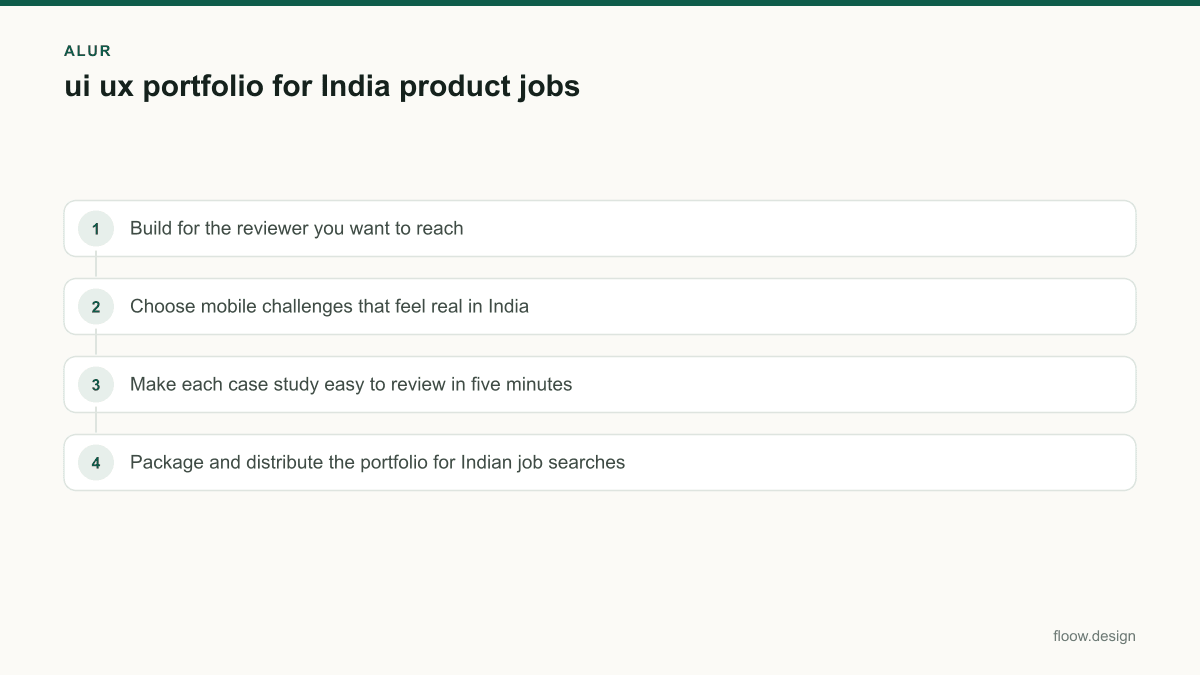
What's on this page
- •Build for the reviewer you want to reach
- •Choose mobile challenges that feel real in India
- •Make each case study easy to review in five minutes
- •Package and distribute the portfolio for Indian job searches
Build for the reviewer you want to reach
Indian product teams do not review portfolios in one uniform way. At a startup, a reviewer often wants to see whether you can take ownership of an ambiguous mobile problem: define the primary user task, make trade-offs, and move from a flow to build-ready screens. Make the rationale visible, not just the final UI.
For an IT services company, include the constraints that shape your work: a client brief, existing design system, hand-off notes, responsive states where relevant, and how you documented decisions for a larger delivery team. Do not imply you owned research or business outcomes you did not own.
For a global capability centre, demonstrate structured problem solving, accessibility awareness, component thinking, and your ability to explain a decision to product, engineering and stakeholders across teams. One case study can be adapted for each audience, but reorder the opening summary. Put ownership, scope, platform, tools and outcome or validation status in the first screen of every case study.
Choose mobile challenges that feel real in India
A strong ui ux case study does not need confidential company work. Create an original concept around a concrete mobile task and clearly label it as a self-initiated project. India-relevant challenges give recruiters something familiar to evaluate.
Use a UPI payment flow to show payment selection, pending or failed states, confirmation and a path back to the order. UPI is operated through the National Payments Corporation of India, so avoid inventing bank rules or claiming that your concept is an official payment specification; treat it as a product-flow exercise and reference the NPCI for ecosystem context.
A commerce flow can examine COD: address confirmation, order review, delivery expectations and what happens when a user changes their mind. An OTP challenge can cover resend timing, wrong-number correction, failed verification and recovery without trapping the user. For multilingual onboarding, show language selection early, account for text expansion, and use realistic content structure rather than translating one English screen word for word. These choices prove that your mobile UI considers states, not only happy-path visuals.
Make each case study easy to review in five minutes
Recruiters scan first and read deeply only when the work earns attention. Start each case study with the product problem, your role, duration, collaborators, target platform and whether the work was shipped, freelance, academic or conceptual. Then show the user journey before showing high-fidelity screens.
A useful sequence is: problem and constraints; assumptions or research inputs; task flow; key design decisions; core mobile screens; edge states; prototype or validation; and what you would change next. If you do not have user data, say that plainly. Replace unsupported success metrics with a test plan, usability observations, or the questions you would validate with users.
Your final screens should form a coherent product, with reusable navigation, fields, buttons, error patterns and payment states. Include a short walkthrough video or clickable prototype only when it clarifies interaction. Recruiters looking for ui ux portfolio examples can assess your thinking faster when annotations explain why a screen exists, what action it supports and how it connects to the preceding state.
Package and distribute the portfolio for Indian job searches
Keep the portfolio mobile-first and fast to open on a phone or laptop. A landing page with a short introduction, two or three case-study cards, a resume link and contact details is enough. Each card should state the product domain and your contribution before asking the reviewer to click.
Use India-focused channels such as Naukri, Cutshort and Instahyre, but do not send an identical application everywhere. Match the first case study to the role: place commerce or payments work first for a fintech or marketplace role; put design-system and stakeholder documentation first for an IT services role; and lead with structured, scalable product work for a global capability centre. Make the portfolio URL visible in your resume header and application profile.
Build original, coherent mobile product screens in floow.design when you need material for a self-initiated concept. Start with a flow and a small component set, then create the UPI, COD, OTP or multilingual states around it. This is more credible than relying on copied portfolio mockups, because reviewers can trace your decisions across an entire product experience.
Common mistakes
Showing only attractive home screens and dashboards.
Include the task flow, decision points, errors, loading or pending states, and the outcome screen for a complete mobile journey.
Calling a redesign a shipped product project.
Label redesigns as self-initiated, explain the assumptions, and distinguish observed issues from hypotheses.
Using one generic case-study introduction for every application.
Reorder the same evidence for startup, IT services or global capability centre expectations and tailor the opening summary.
Copying familiar finance or commerce mockups from portfolio galleries.
Create an original flow and screen system in floow.design, then document the reasoning behind its UPI, COD, OTP or language states.
Frequently asked questions
What should a ui ux portfolio include in India?
A ui ux portfolio for India should include two to three original mobile case studies, a clear statement of your role and project type, task flows, annotated final screens, edge cases and validation or a proposed test plan. India-relevant work such as UPI payments, COD checkout, OTP recovery and multilingual onboarding helps product recruiters assess practical judgement.
How many case studies do Indian recruiters expect?
Indian recruiters can evaluate a portfolio effectively with two to three strong case studies. Each should show a complete mobile problem, your contribution, key decisions, important states and final UI. Add smaller visual projects only if they demonstrate a distinct skill; a large collection of unexplained screens is usually less useful than two deeply documented projects.
Can I use redesign projects in a UI UX portfolio?
You can use redesign projects in a UI UX portfolio if you label them clearly as self-initiated work and do not claim access to company research, metrics or internal constraints. Explain what you observed, what you assumed, the mobile flow you changed, and how you would validate the redesign with users before shipping it.
Should I include UPI or COD work in an India portfolio?
Including a UPI or COD case study can make an India-focused mobile portfolio easier for fintech, commerce and services recruiters to assess. Show the user task and states around it, such as payment pending, failure recovery, confirmation, address review or cancellation. Present the work as a product concept unless you designed it for a real company.
Where this leaves you
For India product roles, a portfolio wins attention when it proves mobile product judgement rather than visual taste alone. Build two or three original case studies, use familiar local flows responsibly, and tailor the story for the company type. Use floow.design to turn your concepts into coherent, original mobile screen systems that stand up to review.
Design the screens first
Describe the app in plain language and floow.design draws the iOS and Android screens for you, ready to refine and hand off.
Sources
Design your mobile app with AI.
Generate pixel-perfect iOS and Android screens in seconds, then export to Figma or code.
You might also like…
 Roundups20 September 2026ui ux portfolio examples for India rolesExplore India-focused mobile app portfolio projects using UPI, COD, OTP, local addresses and Hindi or regional-language flows recruiters can assess.By floow.design Team, Mobile Design
 How-to20 September 2026ui ux interview questions for Indian companiesChecklist of UI UX interview questions for Indian companies: portfolio reviews, whiteboard tasks, stakeholder rounds, UPI, OTP, consent and accessibility.By floow.design Team, Mobile Design
 Insights20 September 2026ui ux designer jobs in India: application guideFind UI/UX roles in India through the right channels, tailor your portfolio for local hiring, and compare CTC offers with global contract work.By floow.design Team, Mobile Design