
ui ux resume for India: examples and checklist
Build a ui ux resume for Indian recruiters: match local job titles, state CTC and notice period clearly, and link evidence-rich mobile case studies.

A ui ux resume for India should match the role title used in the listing, state current location, CTC and notice period when requested, and link to two or three mobile case studies. Make each case study prove decisions with screens and outcomes—for example, a UPI payment flow, ecommerce COD checkout, or OTP authentication redesign.
Key takeaways
- •Mirror the exact role language in the vacancy, such as UI/UX Designer, Product Designer, UX Designer or Interaction Designer.
- •Keep CTC, notice period and current location easy to scan when an Indian recruiter asks for them.
- •Use linked mobile case studies to substantiate claims about research, flows, UI decisions and measured outcomes.
- •Show Indian product constraints through realistic examples including UPI, cash on delivery and OTP authentication.
What's on this page
- •Checklist: match the resume to Indian UI/UX role searches
- •Put CTC, notice period and location where recruiters can find them
- •Turn Indian mobile work into quantified proof
- •Use this one-page structure before applying
Checklist: match the resume to Indian UI/UX role searches
Start with the job title from the vacancy, not a generic headline. Indian searches on Naukri, Cutshort and LinkedIn Jobs commonly surface variants such as UI/UX Designer, UX Designer, Product Designer, Interaction Designer and UI Designer. If the role is UI/UX Designer, use that exact wording in the headline and summary; do not relabel yourself solely as a Product Designer.
Use a one-line headline in this format: UI/UX Designer | Mobile app design | Figma | 3 years. Then add a short summary that names the product work you can prove: consumer mobile flows, design systems, usability testing, developer handoff, or research synthesis.
Before sending, check these items:
- •The target title appears in the headline and recent experience.
- •Skills mirror the listing only when you genuinely use them.
- •The resume prioritises mobile screens and flows over decorative visual work.
- •Every strong claim has a portfolio link or an interview-ready explanation.
- •The file name is professional:
FirstName_LastName_UIUXDesigner.pdf.
This alignment helps recruiters identify fit quickly without changing your actual experience.
Put CTC, notice period and location where recruiters can find them
Indian recruiters often ask for current CTC, expected CTC, notice period and current location during screening. If the application form asks for these values, complete the form accurately. On the resume itself, include them in a compact availability line when they are relevant to the role or already requested by the recruiter.
A practical format is: Based in Bengaluru | Notice period: 30 days | Current CTC: available on request. State a CTC figure only when you are comfortable disclosing it and it is accurate; do not write an invented number or imply that an expected package is your current one. If you are serving notice, say so plainly and give the last working date only if confirmed.
Current location matters because many UI UX designer jobs are tied to Bengaluru, Mumbai, Delhi NCR, Hyderabad, Pune or a hybrid arrangement. Add your city and, if useful, “open to relocate” or “open to remote.” Avoid a full street address, date of birth, family details and a photo unless an employer specifically requires them. The goal is fast screening information, not personal data.
Turn Indian mobile work into quantified proof
A portfolio link should not merely open a gallery of polished screens. It should show what you changed, why you changed it, and what evidence supports the result. For each resume bullet, lead with a product problem and then link to the corresponding mobile case study.
For example: Redesigned UPI payment confirmation and failure-recovery screens; reduced support contacts about pending payments by 18% over the measured release period. Only use a metric that you can verify through analytics, support data or an agreed team report. The UPI context is meaningful for Indian payment products; the National Payments Corporation of India publishes official information about UPI.
Other credible scenarios include simplifying an ecommerce COD selection flow by clarifying address eligibility and order confirmation, or improving OTP authentication by showing resend timing, edit-number access and clear error states. Describe your contribution precisely: research, information architecture, wireframes, UI, prototype testing, or handoff.
Use floow.design screenshots in each linked project to make the mobile flow concrete. Show the key before-and-after screens, empty and error states, and the decision behind them. A recruiter should be able to understand the flow before opening a long case study.
Use this one-page structure before applying
For most early and mid-career applications, keep the resume to one focused page. Place the most decision-useful material in the upper half: role title, portfolio link, experience and outcomes. A recruiter looking at ui ux portfolio evidence should not need to hunt through a separate skills page.
Use this order:
- •Name, title and contact: city, email, LinkedIn and portfolio URL.
- •Summary: two lines tailored to the target role.
- •Skills: Figma, prototyping, mobile UI, user flows, usability testing, design systems and other tools you can discuss.
- •Experience: three to five outcome-led bullets per relevant role.
- •Selected projects: two or three short entries with direct case-study links.
- •Education and certifications: concise and below experience.
Run a final quality check on mobile: links must open, PDF text must be selectable, and case-study URLs should not require a private sign-in. Keep visual styling restrained. Your resume is a screening document; the linked floow.design-supported case studies are where screen-level craft and product thinking become persuasive.
Indian recruiter information to place in a UI/UX application
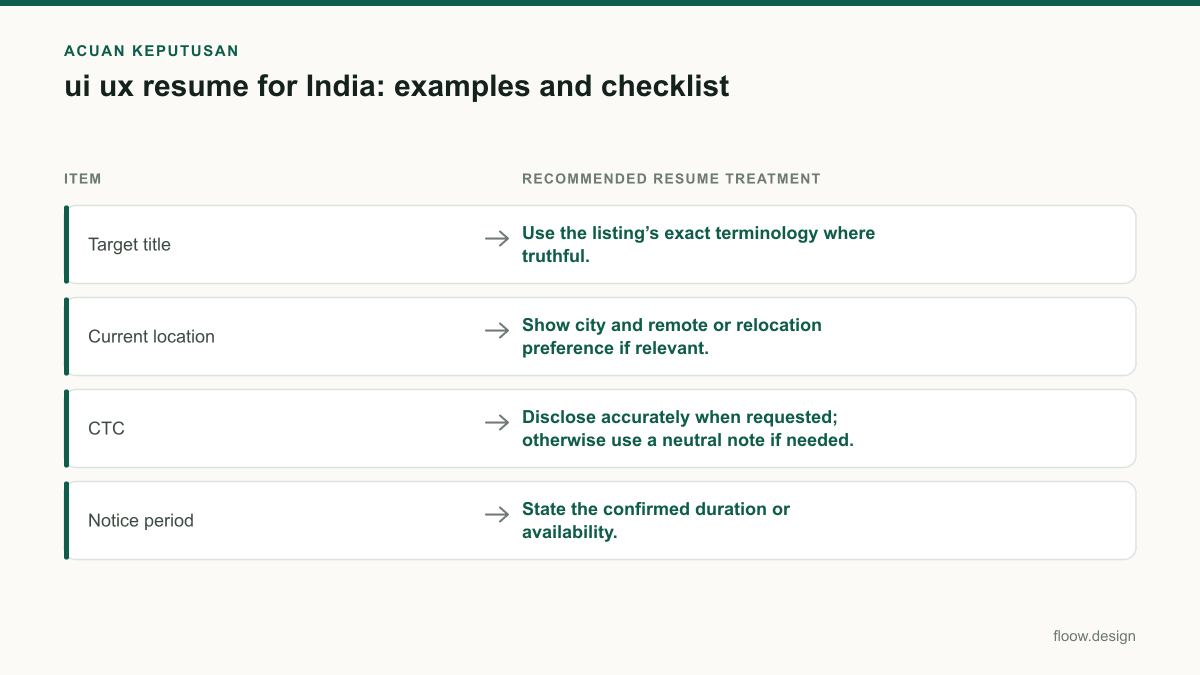
| Item | Recommended resume treatment | Example |
|---|---|---|
| Target title | Use the listing’s exact terminology where truthful. | UI/UX Designer or Product Designer |
| Current location | Show city and remote or relocation preference if relevant. | Hyderabad |
| CTC | Disclose accurately when requested; otherwise use a neutral note if needed. | Current CTC: available on request |
| Notice period | State the confirmed duration or availability. | Notice period: 30 days |
| Portfolio proof | Link directly to a mobile case study with screens and outcomes. | UPI payment recovery flow |
Common mistakes
Using “UI/UX Expert” as a headline for every application.
Match the vacancy’s real title, such as UI/UX Designer, UX Designer or Product Designer, while keeping your experience truthful.
Listing CTC or notice period vaguely, or using outdated information.
Use accurate, current information and disclose compensation details only in the format requested by the employer or recruiter.
Linking to a portfolio landing page with no evidence of mobile product work.
Link directly to two or three case studies that show flows, key states, your role, constraints and verified outcomes.
Claiming impact without a source.
Use a verified metric, name the measurement period where appropriate, or describe the validated learning instead of inventing a number.
Frequently asked questions
How do I write a ui ux resume for India?
Write a ui ux resume for India by matching the exact job title in the listing, adding your current city and availability details, and leading experience bullets with mobile product outcomes. Link each major claim to a focused case study. Use Indian product contexts, such as UPI, COD or OTP flows, only when they reflect work you actually completed or a clearly labelled concept project.
Should I include my CTC and notice period on a UI UX resume?
Include current CTC and notice period on a UI UX resume when the recruiter or application asks for them, and keep both details accurate. A concise availability line can be useful for Indian hiring: “Based in Pune | Notice period: 30 days.” If you do not want to place compensation on the PDF, provide it in the application form or recruiter conversation instead.
How many projects should a UI UX resume link to?
A UI UX resume should usually link to two or three strong mobile case studies. Choose projects that demonstrate different evidence: a payment flow such as UPI, an ecommerce checkout with COD, or OTP authentication. Each link should show your role, the user problem, key screens, states and a verified outcome or research finding rather than a large collection of uncontextualised visuals.
What should I show in a mobile UI/UX case study?
A mobile UI/UX case study should show the product problem, your role, relevant research or constraints, the user flow, final screens and the outcome. Include error, loading and confirmation states where they matter. floow.design screenshots can make the flow legible quickly, especially for payment, checkout and authentication journeys.
Where this leaves you
A strong Indian UI/UX application makes screening details easy to find and backs every claim with mobile evidence. Tailor the title, location, CTC and notice-period information to the role, then use floow.design screenshots to make linked case studies visually specific and credible.
Design the screens first
Describe the app in plain language and floow.design draws the iOS and Android screens for you, ready to refine and hand off.
Sources
Design your mobile app with AI.
Generate pixel-perfect iOS and Android screens in seconds, then export to Figma or code.
You might also like…
 Insights20 September 2026ui ux designer jobs in India: application guideFind UI/UX roles in India through the right channels, tailor your portfolio for local hiring, and compare CTC offers with global contract work.By floow.design Team, Mobile Design
 How-to20 September 2026ui ux interview questions for Indian companiesChecklist of UI UX interview questions for Indian companies: portfolio reviews, whiteboard tasks, stakeholder rounds, UPI, OTP, consent and accessibility.By floow.design Team, Mobile Design
 How-to20 September 2026hire ui ux designer in India: buyer checklistUse this buyer checklist to hire a UI UX designer in India: compare hiring models, test product-flow evidence, and budget in INR with GST.By floow.design Team, Mobile Design