
hire ui ux designer in India: buyer checklist
Use this buyer checklist to hire a UI UX designer in India: compare hiring models, test product-flow evidence, and budget in INR with GST.

To hire ui ux designer in India, assess a candidate on one shared mobile flow—not polished screens alone—and require evidence for relevant UPI, OTP, cash-on-delivery and regional-language states. Compare a full-time hire, freelancer, agency and employer-of-record contractor against your delivery cadence, then request an INR proposal that separates fees, scope and GST.
Key takeaways
- •Use one realistic target flow to compare candidates on decisions, edge cases and handoff quality rather than visual style alone.
- •For Indian consumer products, test UPI, OTP, COD and regional-language behaviour only when the product actually needs them.
- •Ask every agency and freelancer for an INR scope, revision limits, deliverables, ownership terms and GST treatment before comparing totals.
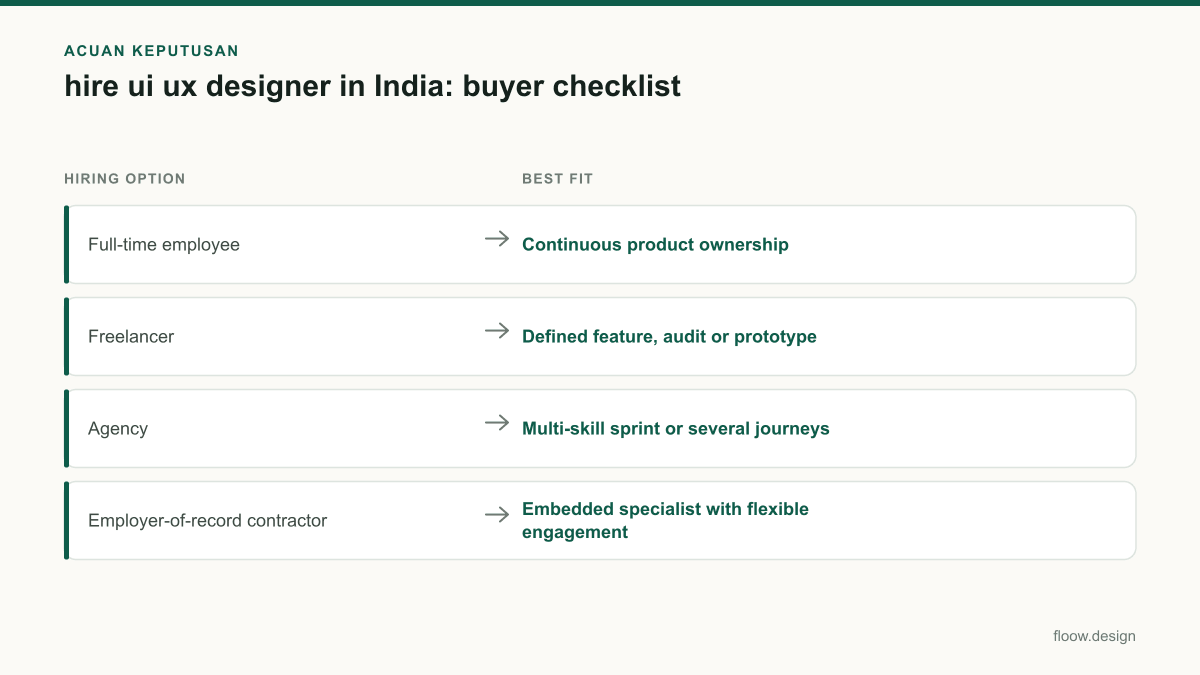
- •Choose the hiring model around ongoing product ownership: full-time for continuity, freelancer for focused work, agency for a cross-functional sprint, and an EOR-engaged contractor for flexible embedded capacity.
What's on this page
- •Start with the product evidence you need
- •Choose the Indian hiring model before comparing quotes
- •Make INR proposals comparable, including GST
- •Run a short, paid evaluation that exposes delivery quality
Start with the product evidence you need
A strong ui ux portfolio can show taste, but it does not prove that its owner can resolve your mobile-product constraints. Before you contact candidates, write a one-page brief for a single target flow: user goal, entry point, completion event, supported platforms, existing design system, engineering constraints and success metric.
For an Indian commerce or payments flow, explicitly state the conditions that matter. A UPI payment can be pending, fail or require the user to return from another app; an OTP screen needs resend, edit-number, expiry and error states; cash on delivery (COD) needs eligibility, address and order-confirmation treatment. If you serve more than one language, ask how the layout, content length, script rendering and language switching will work—not merely whether labels can be translated. UPI is operated through the National Payments Corporation of India; use its published product guidance as a starting point for payment-flow assumptions (NPCI).
Generate this sample target flow in floow.design and give every shortlisted candidate the same brief. Ask for the revised flow, annotations explaining trade-offs, and a short walkthrough. That creates comparable evidence of research, interaction design, mobile UI decisions and developer-ready thinking.
Choose the Indian hiring model before comparing quotes
Compare the engagement model against the work, not against a generic promise of ui ux design services. A full-time employee is best when the designer will own discovery, iterations and design-system maintenance over several releases. Budget as annual cost to company (CTC), plus recruiting, onboarding and management time; a practical planning band is often ₹8 lakh to ₹25 lakh+ annually, depending on seniority and city or remote role.
A freelancer suits a tightly bounded feature, audit or prototype. Set a monthly planning band of roughly ₹75,000 to ₹3 lakh+ and define available days, feedback windows and handoff. An agency is useful when you need research, UX, UI and delivery coordination together; a scoped mobile-flow engagement can be planned from roughly ₹2 lakh to ₹12 lakh+, with price moving materially with research, number of journeys and revision rounds. An employer-of-record contractor gives you an embedded individual while an EOR handles local employment administration; plan the contractor’s monthly fee plus the EOR’s stated service and employment costs rather than assuming it matches a freelancer’s quote.
These are buyer planning bands, not published market rates. Request like-for-like scope and compare the total commitment, not the headline fee.
Make INR proposals comparable, including GST
Ask agencies and freelancers to quote in INR with a line-by-line scope: discovery, user flows, wireframes, UI screens, prototype, usability sessions, design-system work, developer handoff, meetings and post-handoff support. Require assumptions about the number of platforms, journeys, screen states, stakeholders, revision cycles and delivery dates. A proposal that says only “app design” is not comparable.
For GST, ask whether the supplier is GST-registered, whether GST is included or additional, and what the final invoice total will be. For a taxable domestic supply by a registered agency or freelancer, GST is commonly charged at 18%; confirm the treatment for your transaction and eligibility for input tax credit with your finance team or tax adviser. An unregistered supplier may not charge GST, but that does not automatically make the bid cheaper once scope, risk and input-credit position are considered. The official GST portal and Central Board of Indirect Taxes and Customs publish current GST information (GST Portal; CBIC).
For an EOR-engaged contractor, request separate lines for worker compensation, EOR fee, statutory employment costs, equipment allowance if any, and applicable taxes. Put intellectual-property assignment, confidentiality, source-file access and termination or transition support into the agreement before work starts.
Run a short, paid evaluation that exposes delivery quality
Do not commission a speculative full app. Run a paid, time-boxed exercise using the floow.design target flow. Give the candidate the same inputs: brief, brand constraints, two or three business rules, an existing component library if one exists, and a deadline that reflects real collaboration. Pay for the work and make clear whether any resulting material will be used in production.
Evaluate the response in four layers. First, does the designer identify missing product decisions before drawing screens? Second, does the flow cover loading, empty, error, permission, payment and recovery states where relevant? Third, for India-specific requirements, can they explain UPI return and pending states, OTP failure or resend behaviour, COD constraints, and regional-language layout implications? Fourth, can an engineer understand component behaviour, validation, spacing and interaction rules from the handoff?
Ask for one working session with your product manager and engineer. Notice whether the designer frames trade-offs in terms of user completion and operational constraints, not personal visual preference. Check references for scope control, responsiveness to feedback and whether delivered files remained usable after launch. The best fit is the person or team that makes uncertain product decisions visible early.
Indicative INR planning bands for mobile-product design engagements in India
| Hiring option | Best fit | Indicative budget basis | Proposal checks |
|---|---|---|---|
| Full-time employee | Continuous product ownership | ₹8 lakh–₹25 lakh+ annual CTC | Role level, benefits, recruiting time and notice-period plan |
| Freelancer | Defined feature, audit or prototype | ₹75,000–₹3 lakh+ per month | Available days, deliverables, GST status, revisions and source files |
| Agency | Multi-skill sprint or several journeys | ₹2 lakh–₹12 lakh+ per scoped engagement | Research, UX, UI, testing, project management, GST and change requests |
| Employer-of-record contractor | Embedded specialist with flexible engagement | Contractor monthly fee plus EOR and employment costs | Named worker, EOR fee, statutory costs, replacement and transition terms |
Common mistakes
Selecting from hero screens or a Dribbble-style gallery.
Review one end-to-end mobile flow with edge states, rationale and developer handoff. Use the same floow.design brief for every finalist.
Treating UPI as a single success screen.
Require pending, failed, cancelled and return-to-app paths when the product accepts UPI payments.
Asking for “Hindi support” without product rules.
Specify target languages, script and content ownership, language switching, expansion tolerance and which transactional messages are localised.
Comparing a GST-exclusive agency quote with a freelancer’s all-inclusive number.
Request INR totals that state whether GST is included, additional or not charged, then compare the complete commercial commitment.
Frequently asked questions
How do I hire ui ux designer in India?
To hire ui ux designer in India, define one mobile target flow, generate a reference version in floow.design and ask each finalist to respond to the same brief. Compare their reasoning across UPI, OTP, COD or regional-language states when relevant, then select between a full-time employee, freelancer, agency or EOR-engaged contractor based on ownership needs and an INR scope with GST clearly stated.
What should I ask before hiring a UI UX designer?
Before hiring a UI UX designer, ask for relevant end-to-end flow examples, the designer’s role in each project, research and testing methods, edge-state handling, design-system approach, handoff format and availability. For an India-facing mobile app, ask specifically about UPI return or pending states, OTP errors and resend, COD eligibility, and regional-language layout. Also request scope, revisions, IP ownership and GST treatment in INR.
Should I hire a freelancer or agency in India?
Hire a freelancer in India when the mobile design problem is bounded, you can provide product direction and engineering access, and you want direct specialist attention. Hire an agency when you need coordinated research, UX, UI, testing or multiple journeys under one accountable team. Compare both on the same paid flow exercise, then assess total INR cost, GST, delivery capacity, revision process and ownership of files.
How should GST appear on a UI UX design proposal in India?
A UI UX design proposal in India should state the fee in INR, whether the supplier is GST-registered, whether GST is included or added, and the final invoice total. A registered supplier making a taxable domestic supply commonly adds 18% GST, but your finance team should confirm treatment and input-tax-credit eligibility for the specific engagement. EOR proposals should separately identify service and employment-related charges.
Where this leaves you
Hire on demonstrated mobile-product judgment, not attractive mockups. A shared floow.design flow gives Indian candidates a fair brief; a scope-led INR proposal, GST clarity and a paid evaluation give you a decision you can defend.
Design the screens first
Describe the app in plain language and floow.design draws the iOS and Android screens for you, ready to refine and hand off.
Sources
Design your mobile app with AI.
Generate pixel-perfect iOS and Android screens in seconds, then export to Figma or code.
You might also like…
 How-to20 September 2026ui ux resume for India: examples and checklistBuild a ui ux resume for Indian recruiters: match local job titles, state CTC and notice period clearly, and link evidence-rich mobile case studies.By floow.design Team, Mobile Design
 How-to20 September 2026ui ux interview questions for Indian companiesChecklist of UI UX interview questions for Indian companies: portfolio reviews, whiteboard tasks, stakeholder rounds, UPI, OTP, consent and accessibility.By floow.design Team, Mobile Design
 Guides20 September 2026ui ux design services for Indian mobile appsPlan Indian mobile app UI/UX work: UPI, OTP, COD, multilingual journeys, DPDP Act privacy screens, handoff files and GST invoice scope.By floow.design Team, Mobile Design