
ui ux design services for Indian mobile apps
Plan Indian mobile app UI/UX work: UPI, OTP, COD, multilingual journeys, DPDP Act privacy screens, handoff files and GST invoice scope.

ui ux design services for Indian mobile apps should cover product research, user flows, app UI design, prototypes, usability checks and developer handoff. A credible scope also designs UPI payment states, OTP verification failures, cash-on-delivery choices, multilingual content patterns and consent/privacy screens shaped by the DPDP Act, 2023.
Key takeaways
- •Define the engagement around complete mobile journeys, not a count of attractive screens.
- •Include India-specific payment, verification, delivery and language states in the scope from the start.
- •Use floow.design during discovery to visualise the proposed app scope before commissioning a full UI/UX engagement.
- •Confirm invoice treatment early: GST at 18% is a typical consideration for Indian agency service invoices.
- •Ask for editable source files, component rules, prototype links and a developer-ready handoff.
What's on this page
- •What to expect from an Indian mobile UI/UX engagement
- •Use discovery to make the scope visible before hiring
- •Privacy, consent and multilingual screens are product work
- •Deliverables, cost conversations and handoff criteria
What to expect from an Indian mobile UI/UX engagement
A useful ui ux design services engagement starts by turning a business brief into a mobile product plan: target users, core jobs, feature priorities, platform assumptions and measurable conversion events. For an Indian consumer app, the scope should explicitly map onboarding, phone-number entry, OTP delivery and retry states, account recovery, UPI selection and payment outcomes, and cash-on-delivery (COD) selection where orders are fulfilled offline.
The service should then move through information architecture, task flows, low-fidelity wireframes, visual direction, high-fidelity app UI design, clickable prototypes, validation and handoff. Do not accept a proposal that lists only “screens.” Ask which states are included: invalid OTP, expired OTP, UPI pending, payment failed, payment cancelled, address errors, COD availability and order-status notifications. UPI is operated through the NPCI ecosystem, so payment designs need clear status handling rather than an assumed instant success state. Reference: NPCI.
For products serving more than one language, define content ownership, translation review and layouts that can expand before visual design begins. This avoids rebuilding navigation and forms after Hindi or another supported language is introduced.
Use discovery to make the scope visible before hiring
Before you hire ui ux designer talent or appoint an agency, use floow.design in discovery to visualise the proposed Indian app scope. Create the key journeys first: sign-up with mobile number and OTP, browse or search, product or service selection, UPI or COD checkout, order tracking, support and consent controls. Generated screens give stakeholders something concrete to review before a full commission begins.
This is especially helpful when the brief contains ambiguous requests such as “support UPI,” “make it multilingual” or “add privacy.” Turn each into a visible flow and list its edge states. For example, a payment journey may need a UPI-app return state, pending confirmation, failed payment guidance and a safe retry. A multilingual journey may need a language selector, translated labels, adaptable text containers and a decision on whether names, addresses and numeric input remain in a single format.
Discovery output is not a substitute for research or production design. It is a scope artefact: use it to align product, operations, engineering and compliance teams, identify missing journeys, and request a comparable proposal from each provider. Then commission research, tested prototypes and developer-ready design work against the agreed flow inventory.
Privacy, consent and multilingual screens are product work
Privacy screens should not be left until the final polish pass. The Digital Personal Data Protection Act, 2023 makes consent and personal-data handling relevant product-design concerns for Indian apps. A UI/UX team should identify where the app requests personal data, what the user sees before agreeing, how choices are recorded in the interface, and where users can find privacy-related controls. Legal counsel should approve the wording and operating model; designers should make the approved choices understandable in the mobile journey. Official reference: MeitY.
For OTP-led onboarding, keep the purpose of phone-number collection clear and design alternatives where the product supports them. Avoid making consent copy visually subordinate to the primary action when it is material to the user’s choice. Build error and recovery paths too, not only the ideal verification path.
Hindi screens deserve the same design attention as English screens. A capable team checks line breaks, label length, font rendering, mixed-script strings, date and number presentation, and whether support content is actually available in the selected language. Android’s official documentation covers localisation practices and resource handling that can inform the handoff. Reference: Android Developers.
Deliverables, cost conversations and handoff criteria
A commercial proposal should state the deliverables and their limits: research plan, interview or usability-test participation, journey maps, wireframes, design system or component library, high-fidelity screens, prototype, copy guidance, accessibility checks, annotations and post-handoff support. Agree whether iOS and Android variants are included, whether design covers a new feature or the full app, and how many review rounds are available.
Avoid treating a price as meaningful without this definition. UI/UX service cost in India varies materially with product complexity, research depth, number of languages, number of payment and delivery states, seniority of the team, and whether design-system and developer-support work are included. Compare proposals by the journeys and states covered, not by screen count alone.
Ask the supplier how tax is shown on the invoice. GST at 18% is a typical consideration on Indian agency service invoices, subject to the supplier’s registration, place-of-supply details and the specific transaction. Confirm the applicable treatment with the agency and your finance adviser. The GST portal is the official starting point for GST information: GST.
At handoff, require editable design files, component specifications, interaction notes, asset exports, responsive or device rules, a prototype link, and a tracked list of unresolved decisions. Engineering should review this package before build starts.
India-specific items to place in the UI/UX scope
| Area | What the scope should include | Why it matters |
|---|---|---|
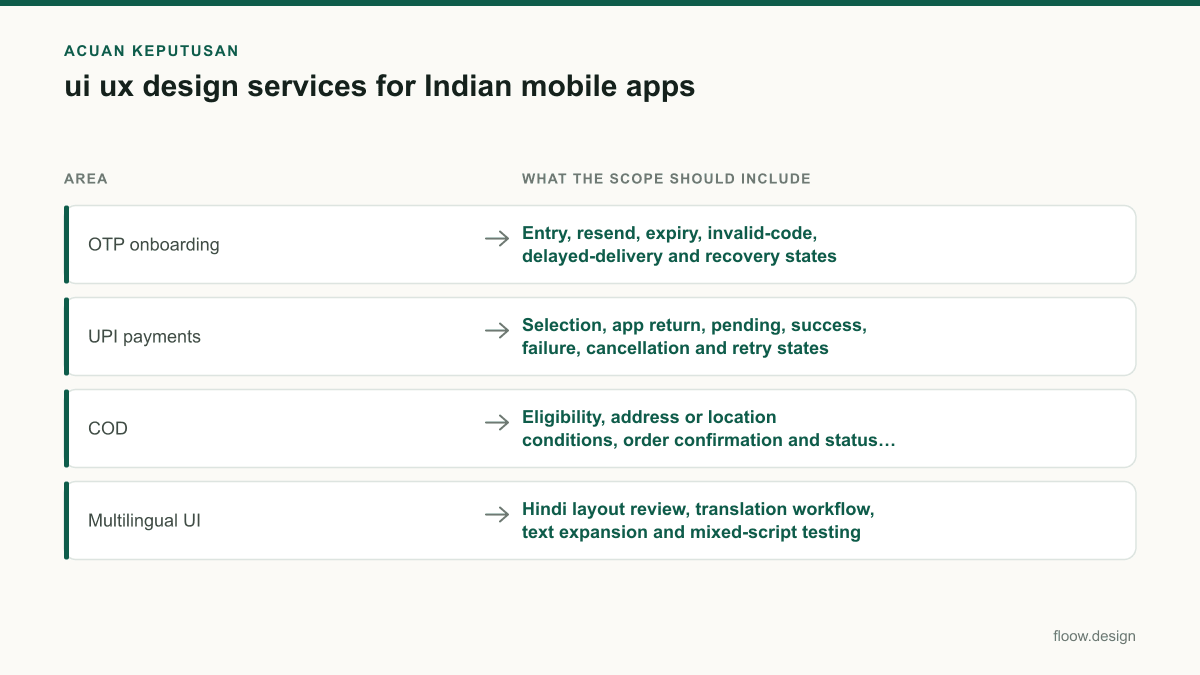
| OTP onboarding | Entry, resend, expiry, invalid-code, delayed-delivery and recovery states | Phone-number verification is a core mobile journey and needs more than one happy-path screen. |
| UPI payments | Selection, app return, pending, success, failure, cancellation and retry states | Payment completion can have multiple user-visible outcomes. |
| COD | Eligibility, address or location conditions, order confirmation and status communication | COD is an operational choice that affects checkout and post-order screens. |
| Multilingual UI | Hindi layout review, translation workflow, text expansion and mixed-script testing | Language support changes content and component behaviour. |
| Privacy and consent | Approved notice, meaningful choices and access to privacy controls | The DPDP Act, 2023 makes this a product and compliance collaboration area. |
| Agency invoice | Clear fee, scope assumptions and GST treatment | GST at 18% is a typical consideration for Indian agency service invoices. |
Common mistakes
Buying a fixed number of screens without listing payment, OTP, COD and error states.
Contract against user journeys and state coverage, then use screen count only as a planning aid.
Adding Hindi after the English app UI has been signed off.
Include Hindi content review, text expansion checks and localisation acceptance criteria in the first design scope.
Treating the privacy notice as legal text to paste into a final screen.
Bring legal, product and design together early to map notices, choices and privacy-control entry points shaped by the DPDP Act, 2023.
Comparing quotes before clarifying research, prototypes, design-system work and handoff support.
Issue one flow inventory and deliverable checklist to every prospective provider, including invoice and GST assumptions.
Frequently asked questions
What is included in ui ux design services in India?
ui ux design services in India commonly include discovery, user and task flows, wireframes, app UI design, clickable prototypes, usability validation and developer handoff. For a mobile product, the agreed scope should also specify India-relevant states for OTP verification, UPI payments, COD checkout, multilingual journeys and privacy or consent screens shaped by the DPDP Act, 2023.
How much do UI UX design services cost in India?
UI UX design services cost in India depends on the product’s complexity, research depth, number of mobile journeys, supported languages, platform variants, design-system needs and handoff support. Compare proposals by included flows and edge states rather than screen count. GST at 18% is also a typical consideration on Indian agency service invoices, so confirm invoice treatment before approving a budget.
Should a UI UX agency design Hindi screens?
A UI UX agency should design Hindi screens when Hindi is a supported product language, rather than relying on unreviewed English layouts after translation. The work should cover translated content, font rendering, text expansion, mixed-script labels, form behaviour, support content and usability review. Android localisation guidance can help engineering and design agree on implementation rules.
How can floow.design help before a full Indian UI/UX project?
floow.design can help teams visualise an Indian mobile app’s proposed scope during discovery before commissioning a full UI/UX engagement. Build and review representative OTP, UPI, COD, multilingual and privacy journeys, then use those screens to align stakeholders and request comparable agency proposals. Production research, validation and developer handoff should still be defined in the final service scope.
Where this leaves you
Choose a UI/UX partner on its ability to define and design the real Indian mobile journey: OTP recovery, UPI outcomes, COD operations, multilingual content and informed privacy choices. Visualise that journey in floow.design first, then commission the research, production UI and handoff package required to build it.
Design the screens first
Describe the app in plain language and floow.design draws the iOS and Android screens for you, ready to refine and hand off.
Sources
Design your mobile app with AI.
Generate pixel-perfect iOS and Android screens in seconds, then export to Figma or code.
You might also like…
 How-to20 September 2026hire ui ux designer in India: buyer checklistUse this buyer checklist to hire a UI UX designer in India: compare hiring models, test product-flow evidence, and budget in INR with GST.By floow.design Team, Mobile Design
 Guides20 September 2026ux writing for Indian mobile appsA practical guide to UX copy for Indian apps: UPI, OTP, KYC, payment failures, multilingual expansion and DPDP Act consent wording.By floow.design Team, Mobile Design
 Insights20 September 2026ui ux freelance: getting clients in IndiaGet ui ux freelance clients in India: build a sellable portfolio, price discovery and delivery, invoice correctly, and collect payments clearly.By floow.design Team, Mobile Design