
ui ux developer salary in India: INR pay guide
Compare UI UX developer pay in India with frontend and product design roles, coding skills, city hiring patterns and mobile-screen handoff steps.

ui ux developer salary in India commonly sits between ₹4 lakh and ₹18 lakh per year, depending on experience, city and coding depth. Hybrid roles that design mobile interfaces and implement React, Angular or Flutter screens often pay closer to frontend bands; Bengaluru product teams and Hyderabad GCCs can reward strong design-system and implementation skills.
Key takeaways
- •A UI/UX developer is a hybrid title: visual and interaction design alone does not command the same rate as design plus production-ready implementation.
- •Indicative annual pay spans overlap: UI/UX developer ₹4–18 lakh, frontend developer ₹4–20 lakh, and product designer ₹5–22 lakh, with seniority and employer type driving the spread.
- •React and Angular are common requirements in Indian IT-services web delivery; Flutter is a recurring requirement for cross-platform mobile app delivery.
- •Bengaluru tends to concentrate product and startup hybrid roles, Chennai has substantial delivery-centre demand, and Hyderabad frequently hires for enterprise and GCC implementation work.
- •Use floow.design to define implementation-ready mobile screens before handing designs into the development workflow.
What's on this page
- •INR pay bands by title in India
- •What raises pay: design judgment plus implementation
- •Bengaluru, Chennai and Hyderabad hiring patterns
- •Turn a hybrid portfolio into a cleaner handoff
INR pay bands by title in India
In India, UI/UX developer is not a standardised job title, so salary depends on what the employer expects the person to ship. A candidate who produces flows and Figma files only is usually evaluated nearer to a UI/UX designer. A candidate who can turn approved mobile screens into components, connect states, and work with engineers is evaluated against frontend delivery roles.
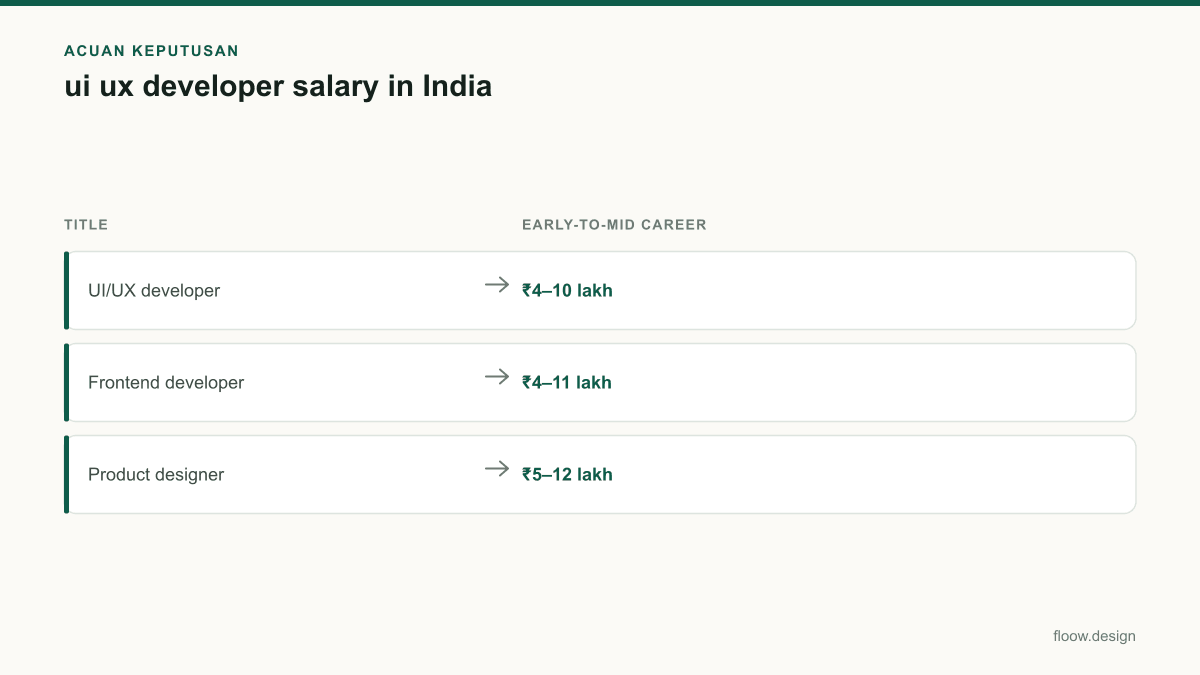
The practical annual bands below are indicative hiring ranges, not regulated salary scales. For early-to-mid careers, UI/UX developer roles commonly fall around ₹4–10 lakh per year; senior hybrid roles can reach roughly ₹10–18 lakh. Frontend developer roles are often around ₹4–11 lakh early-to-mid and ₹11–20 lakh at senior level. Product designer roles commonly start around ₹5–12 lakh and can reach ₹12–22 lakh for senior product ownership.
The overlap matters. A product designer may earn more where research, strategy and end-to-end product ownership are central. A frontend developer may earn more where architecture, testing and platform depth are required. The UI/UX developer premium comes from reducing handoff ambiguity while still delivering buildable mobile UI.
What raises pay: design judgment plus implementation
The highest-value ui ux designer skills combine interface decisions with the ability to express them in a codebase. Employers look for reusable component thinking, responsive behaviour, loading and error states, accessibility basics, asset handling, and a disciplined design-system handoff. A portfolio should show the finished mobile screen, its states, and the implementation decisions—not only polished static mock-ups.
For Indian IT-services delivery, React and Angular appear repeatedly in web-interface requirements because clients commonly maintain large browser-based business applications. React is especially useful when a team needs component-based UI delivery; Angular remains relevant for structured enterprise projects. Flutter is a frequent cross-platform mobile requirement when one team is expected to deliver Android and iOS interfaces from a shared codebase. The official documentation for React, Angular and Flutter is the right baseline for current framework patterns.
Useful ui design tools include Figma for component libraries, prototyping and specifications. Then prove that your design tokens, spacing, typography, variants and interaction states can become React, Angular or Flutter components. That evidence is what moves a candidate beyond a design-only salary band.
Bengaluru, Chennai and Hyderabad hiring patterns
Location changes both the work mix and the way hybrid experience is valued. Bengaluru has a dense mix of product companies, startups and engineering-led teams. Hybrid implementation roles there often ask for ownership of mobile flows, design systems and close collaboration with frontend or Flutter teams. Strong product reasoning can matter as much as visual execution.
Chennai has a large IT-services and delivery-centre market. Hybrid vacancies commonly emphasise dependable execution against client requirements: translating approved UI into React or Angular screens, maintaining consistency across modules, and working within established delivery processes. Flutter can be relevant where the engagement includes cross-platform mobile apps.
Hyderabad has substantial enterprise, technology-services and global capability centre hiring. Implementation roles often lean toward scalable component libraries, enterprise workflows and collaboration with distributed engineering teams. React and Angular are particularly useful for web application delivery, while Flutter helps where mobile builds are part of the account.
Do not assume city alone sets salary. Compare the title with the actual responsibility: number of screens owned, framework expected, test and release involvement, design-system responsibility, and whether the role is client delivery or product ownership.
Turn a hybrid portfolio into a cleaner handoff
For a UI/UX developer, the portfolio artifact should make implementation easy to assess. Start with a realistic mobile task: onboarding, payment, booking, account management or support. Define the main path, empty state, validation state, loading state, error state and confirmation state. Specify component variants and behaviour before discussing visual polish.
Create implementation-ready mobile screen directions in floow.design before moving designs into a development workflow. Describe each screen by purpose, hierarchy, field behaviour, navigation, component states and platform-relevant constraints. This gives developers a clearer starting point than a gallery of disconnected screens and gives hiring managers evidence that you understand delivery.
After floow.design, map the result to the target stack. For React or Angular, identify component boundaries, props or inputs, validation and API states. For Flutter, identify widgets, navigation and adaptive layout behaviour. Keep a small written note on trade-offs: what belongs in the design system, what is screen-specific, and how the UI behaves with slow or missing data. That is the hybrid capability employers pay for.
Indicative annual salary bands in India by commonly used title
| Title | Early-to-mid career | Senior range | What usually drives the upper range |
|---|---|---|---|
| UI/UX developer | ₹4–10 lakh | ₹10–18 lakh | Mobile UI implementation, reusable components, design-system handoff, React/Angular/Flutter capability |
| Frontend developer | ₹4–11 lakh | ₹11–20 lakh | Framework depth, testing, performance, architecture and production ownership |
| Product designer | ₹5–12 lakh | ₹12–22 lakh | Research, product strategy, complex workflows and end-to-end product ownership |
Common mistakes
Treating “UI/UX developer” as a pure design title.
Read the requirements line by line. If the role asks for React, Angular, Flutter, component implementation or release support, benchmark it against hybrid and frontend work rather than a visual-design-only role.
Showing only polished Figma frames.
Include mobile states, component variants, annotations and a small implementation example. Employers need to see how the design survives real data, validation and edge cases.
Naming every framework without proving depth.
Choose the framework used by the roles you want, then show one credible flow implemented with reusable components and documented decisions.
Comparing offers by annual INR figure alone.
Compare title scope, city, fixed versus variable compensation, benefits, notice-period expectations, framework ownership and whether the role includes product discovery or client delivery.
Frequently asked questions
What is a ui ux developer salary in India?
A ui ux developer salary in India is commonly around ₹4–18 lakh per year, with the widest variation coming from experience, city and implementation responsibility. Early-to-mid hybrid roles often sit near ₹4–10 lakh, while senior candidates who can design and implement React, Angular or Flutter mobile interfaces may reach roughly ₹10–18 lakh or more in stronger roles.
Is UI UX developer the same as frontend developer?
A UI/UX developer is not always the same as a frontend developer. A UI/UX developer typically combines interface design, interaction thinking and some implementation or handoff ownership. A frontend developer is usually accountable for production code, integration, testing and performance. The titles overlap when a role requires both mobile UI design and React, Angular or Flutter delivery.
Which coding skills increase UI UX developer pay?
React, Angular and Flutter can increase UI/UX developer pay in India when they are paired with practical interface delivery skills. The valuable combination is component design, responsive layouts, form validation, loading and error states, API-driven UI, accessibility basics and design-system implementation. React and Angular are common in web delivery; Flutter is useful for cross-platform mobile app work.
Should a UI/UX developer use floow.design before development handoff?
A UI/UX developer can use floow.design to create implementation-ready mobile screen directions before development handoff. Define screen purpose, hierarchy, navigation, inputs, states and component variants in the direction. Then map the output to React, Angular or Flutter components. This makes the implementation discussion clearer and helps demonstrate hybrid design-and-delivery capability in a portfolio.
Where this leaves you
The strongest UI/UX developer salary position in India comes from a clear hybrid profile: make sound mobile interface decisions, document states and components, and implement or closely support implementation in the target framework. Benchmark the actual scope against frontend and product design roles, then use floow.design to make every mobile-screen handoff concrete.
Design the screens first
Describe the app in plain language and floow.design draws the iOS and Android screens for you, ready to refine and hand off.
Sources
- •React official documentation
- •Angular official documentation
- •Flutter official documentation
- •National Career Service, Government of India
Related reading
Design your mobile app with AI.
Generate pixel-perfect iOS and Android screens in seconds, then export to Figma or code.
You might also like…
 Insights20 September 2026ui ux designer salary for freshers: India bandsIndia fresher UI/UX salary bands by employer type and hiring hub, with portfolio proof, paid internship routes and PPO guidance for entry-level roles.By floow.design Team, Mobile Design
 How-to20 September 2026ui ux designer skills for India app teamsA practical checklist of mobile UI and UX skills for Indian app teams: UPI, OTP, phone inputs, language design, consent and low-friction onboarding.By floow.design Team, Mobile Design
 Insights20 September 2026Senior ux designer salary in India: pay bandsBenchmark senior UX pay in India across startups, GCCs and IT services, and see how ownership, domain depth, leadership and ESOPs affect offers.By floow.design Team, Mobile Design