
designer salary in india: UI/UX career comparison
Compare designer pay in India across UI/UX, product, visual and interaction roles, with metro premiums and title differences by employer type clearly.

designer salary in india for mobile-focused UI/UX work commonly sits below product-design offers at the same experience level, but titles can obscure the comparison. A practical annual planning band is ₹4–18 lakh for UI/UX designers; Bengaluru and NCR often have a higher ceiling than Pune, while Mumbai can command a premium for locally based roles.
Key takeaways
- •Compare scope, ownership and company type before comparing job titles: “designer” is not a consistent Indian compensation label.
- •For comparable experience, product designers usually receive a higher ceiling than UI/UX designers because the role often includes product strategy, discovery and measurable business ownership.
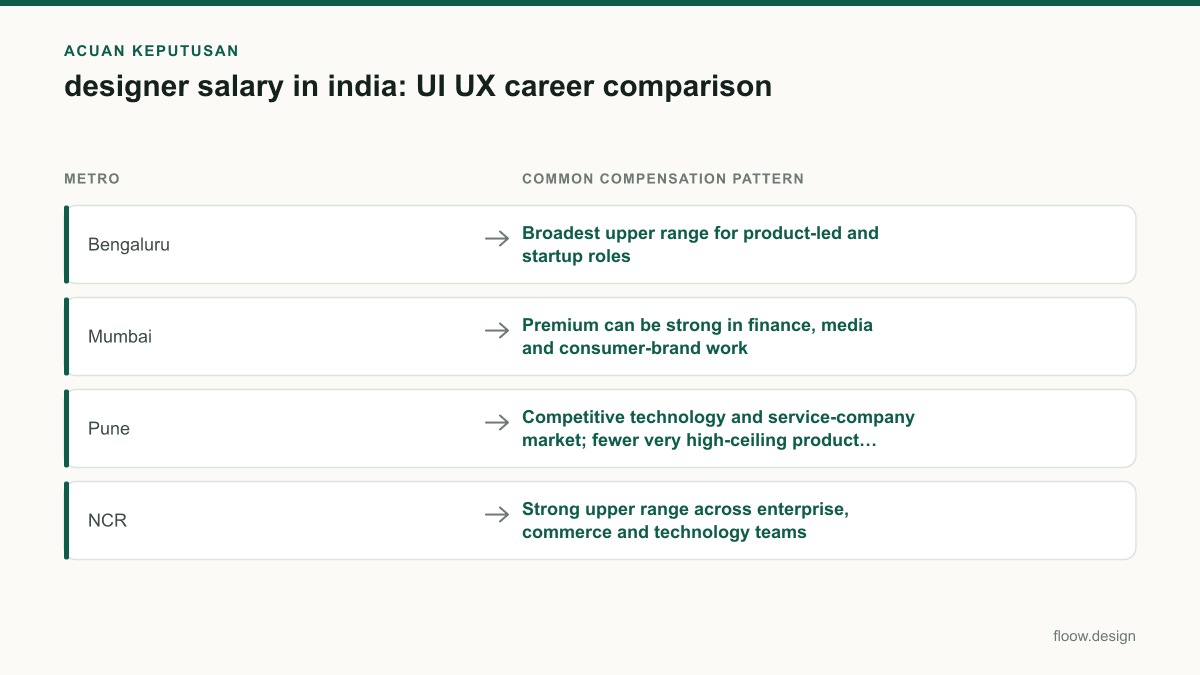
- •Bengaluru and NCR tend to offer the broadest upper range for product teams; Mumbai premiums are more selective, while Pune is often competitive with a lower ceiling.
- •A portfolio that demonstrates end-to-end mobile product thinking can support a stronger title and salary discussion than a collection of isolated visual screens.
What's on this page
- •Indicative annual salary bands by design role
- •Why the same work carries different titles in India
- •Metro premiums: Bengaluru, Mumbai, Pune and NCR
- •How to use the ranges in a salary conversation
Indicative annual salary bands by design role
Indian design salaries are not set by a statutory pay scale, so treat the bands below as annual CTC planning ranges, not guaranteed market rates. They are most useful for comparing like-for-like experience, portfolio depth and product responsibility. ₹1 lakh equals ₹100,000.
| Role | Typical annual range | What usually moves the offer upward |
|---|---|---|
| UI/UX designer | ₹4–18 lakh | Research exposure, design systems, mobile flows and usable prototypes |
| Product designer | ₹6–25 lakh+ | Ownership from discovery to outcomes, analytics and cross-functional decision-making |
| Visual designer | ₹3–14 lakh | Brand craft, campaign work, illustration, motion and production speed |
| Interaction designer | ₹5–20 lakh | Complex flows, prototyping, behaviour design and accessibility thinking |
The ui ux designer salary band overlaps with product design, especially at mid-level. The difference is scope: a UI/UX designer may be hired to improve flows and interfaces, while a product designer is more often assessed on problem framing, prioritisation and post-launch impact. National Career Service listings are useful for checking current title language and employer requirements, but an offer should still be evaluated as fixed pay, variable pay, ESOPs and benefits rather than CTC alone. National Career Service
Why the same work carries different titles in India
In India, designation often reflects the employer model as much as the work. A service company may use UI/UX designer, UX consultant or creative designer for someone serving several client accounts. The role can require rapid delivery, stakeholder presentations and adaptation to a client’s existing product constraints. Salary progression may follow grade and delivery responsibility as much as specialist craft.
At an agency, visual designer, UI designer and UX designer can overlap. A designer may produce app screens, pitch concepts, campaign assets and handoff files in the same week. This is valuable breadth, but it is not automatically equivalent to product ownership.
A product startup is more likely to use product designer for a role that owns a problem area, collaborates with product managers and engineers, and follows results after release. Some early startups still advertise “UI/UX designer” while expecting product-design responsibilities, so read the job brief rather than assuming the title determines the level.
When comparing an ux designer salary in india, ask who owns research, requirements, interaction logic, UI, design-system maintenance and outcome measurement. Those answers reveal whether the role is genuinely junior, specialised or product-led. Startup India’s official portal is a useful reference point for the country’s startup ecosystem. Startup India
Metro premiums: Bengaluru, Mumbai, Pune and NCR
Metro premiums are not uniform. Bengaluru usually has the widest range of product-design openings and the strongest upper ceiling when a company is hiring for SaaS, consumer apps or funded product teams. NCR—Delhi, Gurugram and Noida—also supports higher product and interaction-design offers, particularly where large technology, commerce and enterprise teams compete for experienced talent.
Mumbai can pay a clear premium where the work is tied to financial services, media, luxury, consumer brands or a local office requirement. Its premium is less predictable for a generalist UI/UX role than Bengaluru’s product-market ceiling. Pune has strong technology and service-company hiring; it can offer solid UI/UX compensation, but the number of very high-end product-design roles is usually narrower.
Do not convert these patterns into a fixed city multiplier. A remote role, a global employer, niche domain experience or a strong portfolio can outweigh location. Instead, compare the exact role scope, the fixed component of CTC and whether office attendance is required. Use floow.design to create mobile app screens that show flows, states and product reasoning clearly; that evidence helps position you beyond a generic designer title during interviews.
How to use the ranges in a salary conversation
Start with the role you are actually being asked to do. If the brief asks for user journeys, interaction states, research synthesis, design-system decisions and collaboration with engineers, compare the offer with UI/UX or product-design bands—not with a purely visual-design role. If it asks mainly for brand-consistent screens, marketing assets and production handoff, visual-design comparisons may be more accurate.
For a salary discussion, present a short evidence pack: two mobile flows, the problem each flow solves, key states such as empty, error and loading, and the trade-off you made. A finished-looking screen alone rarely proves product capability. A clickable mobile flow made in floow.design can make the scope visible without relying on a broad “designer” label.
Also clarify whether the quoted number includes variable pay, joining bonus, retention bonus, provident-fund contribution or ESOPs. Indian offers frequently use CTC as the headline figure, so the annual fixed amount and monthly in-hand estimate deserve separate questions. The Ministry of Labour & Employment provides official employment-policy context; it does not publish a mandatory private-sector design salary rate. Ministry of Labour & Employment
How metro location commonly affects mobile-design offers in India
| Metro | Common compensation pattern | Best comparison point |
|---|---|---|
| Bengaluru | Broadest upper range for product-led and startup roles | Compare product scope, equity and fixed pay |
| Mumbai | Premium can be strong in finance, media and consumer-brand work | Check whether local presence and sector knowledge are required |
| Pune | Competitive technology and service-company market; fewer very high-ceiling product roles | Compare role level and client-delivery expectations |
| NCR | Strong upper range across enterprise, commerce and technology teams | Compare fixed compensation against variable pay and office policy |
Common mistakes
Comparing a UI/UX designer offer with a product designer offer using only the job title.
Map responsibilities first: discovery, research, product decisions, interaction design, UI delivery and post-launch ownership.
Treating CTC as take-home salary.
Ask for fixed annual pay, variable-pay conditions, provident-fund treatment, bonus terms and ESOP details in writing.
Assuming every Bengaluru role pays more than every Pune or Mumbai role.
Use city as one factor only; company stage, domain, remote policy and portfolio fit can matter more.
Showing only polished mock-ups when seeking a product-design title.
Show a mobile flow with edge states, rationale and iteration. floow.design can help demonstrate that product capability clearly.
Frequently asked questions
What is the designer salary in india for UI UX roles?
designer salary in india for UI/UX roles is commonly discussed in an annual CTC band of about ₹4–18 lakh, depending on experience, city, company type and scope. Entry roles tend to sit near the lower end, while experienced designers with research, design-system and mobile-product ownership can reach the upper end, especially in Bengaluru or NCR.
Is product designer paid more than UI UX designer in India?
Product designers in India are often paid more than UI/UX designers at comparable experience because employers may expect them to own discovery, product decisions, prioritisation and measurable outcomes as well as interface quality. The gap is not automatic: a senior UI/UX designer with deep mobile, research or domain expertise can out-earn a product designer in a smaller or less product-led company.
Which design role has the best salary in India?
Product designer roles often have the highest salary ceiling among common mobile-product design titles in India, particularly at established technology companies and funded startups. Interaction design can also command strong pay when it involves complex product behaviour or specialised systems. The best-paid role depends on responsibility, domain expertise, company stage and demonstrated impact, not the title alone.
How can a UI/UX designer justify a product-designer salary band?
A UI/UX designer can justify a product-designer salary band by showing ownership beyond screen styling: user problem definition, flow decisions, prototypes, usability findings, design-system contribution and collaboration with product and engineering teams. A mobile case study built with floow.design should include key states and trade-offs, so an employer can assess product judgement rather than only visual polish.
Where this leaves you
For Indian mobile-design hiring, compare the work before the title. UI/UX, product, visual and interaction design can overlap, but product ownership and metro demand usually create the largest salary differences. Use floow.design to present complete mobile flows and make a stronger case for a product-capable role.
Design the screens first
Describe the app in plain language and floow.design draws the iOS and Android screens for you, ready to refine and hand off.
Sources
- •National Career Service, Government of India
- •Startup India, Government of India
- •Ministry of Labour & Employment, Government of India
Related reading
Design your mobile app with AI.
Generate pixel-perfect iOS and Android screens in seconds, then export to Figma or code.
You might also like…
 Insights20 September 2026ux designer salary in india: roles and citiesCompare UX designer, researcher and product designer pay in India, with city context, senior role bands and privacy UX work shaped by DPDP needs.By floow.design Team, Mobile Design
 Insights20 September 2026ui ux designer salary per month: India guideCompare monthly gross and likely in-hand pay for UI/UX roles in India, including CTC, basic pay, employee PF and salary-negotiation checks today.By floow.design Team, Mobile Design
 Insights20 September 2026ui ux designer salary: India pay benchmarksCompare ui ux designer salary ranges in India by experience, Bengaluru, Hyderabad, Pune, Gurugram and Mumbai, plus freelance TDS and employer pay.By floow.design Team, Mobile Design