
ecommerce app design for Indian shoppers
Plan ecommerce app design for Indian shoppers: UPI, COD, EMI, PIN-code delivery checks, address capture, trust cues and mobile checkout patterns.

ecommerce app design for India should make delivery eligibility, payment choice and order trust visible early. Build a checkout that supports UPI, cash on delivery and EMI, then collect a valid Indian PIN code, multi-line address and optional landmark before payment. Benchmark the mobile flows of Flipkart, Meesho, Myntra and Amazon India.
Key takeaways
- •Show PIN-code serviceability before shoppers invest time in a product or checkout flow.
- •Treat UPI, cash on delivery and EMI as first-class payment choices, with clear availability and failure states.
- •Use structured but flexible address entry: PIN code, house or flat, street or area, landmark, city and state.
- •Use familiar Indian marketplace patterns for trust: delivery date, return context, payment confirmation and visible customer support routes.
- •Test checkout, address and payment assumptions as connected mobile screens rather than as isolated app ui design components.
What's on this page
- •Start with the Indian checkout decision order
- •Make the address form work beyond a single-line address
- •Benchmark marketplace conventions, then prototype the edge cases
- •Screen checklist for an India-ready purchase flow
Start with the Indian checkout decision order
In Indian mobile commerce, payment is not a final utility screen. It is a purchase decision. Put UPI, cash on delivery (COD) and EMI where shoppers can compare them without opening several layers of UI. Use a selected state, a concise explanation of the next step, and a clear fallback when a method is unavailable for an order or delivery location.
For UPI, show the handoff state plainly: the customer is about to approve a payment in their UPI app, then returns to the shopping app for confirmation. Do not mark an order as paid until the payment result is confirmed. For COD, state the payable amount and any eligibility restriction before the shopper places the order. For EMI, make the plan details, issuer or provider selection, tenure and resulting payable amount reviewable before confirmation.
The National Payments Corporation of India publishes the UPI product information at NPCI. Use that official terminology in labels rather than inventing payment names. In app ui design, reserve enough vertical space for payment errors, retries and switching methods; a compact radio list is not enough when a customer needs to recover from a declined or interrupted payment.
Make the address form work beyond a single-line address
A delivery address for India needs more than name, phone and a generic address box. Ask for a PIN code early, because serviceability and delivery expectations can depend on it. Then support a multi-line address pattern that lets a shopper enter house, flat or building details separately from street, locality or area. Provide an optional landmark field for directions that do not fit a formal postal address.
A practical mobile sequence is: PIN code, house or flat and building, street or area, landmark, city and state, followed by a delivery-address label such as Home or Work. Prefill city and state only after the PIN-code lookup is confirmed, and always allow correction. Never make landmark mandatory: it is useful for finding an address, but not every customer has one.
India Post is the official postal authority and maintains PIN-code information through India Post. Design validation as assistance, not punishment. Keep typed address text intact if a PIN code is changed, explain an unserviceable location next to the affected control, and return the shopper to the product or cart with their selection preserved. This prevents address failure from becoming cart abandonment.
Benchmark marketplace conventions, then prototype the edge cases
Use Flipkart, Meesho, Myntra and Amazon India as local benchmarks for the sequence shoppers already recognise: delivery-location confirmation, product-level delivery context, address selection, payment selection and order-status reassurance. Do not copy their visuals or assume every pattern is right for your category. Instead, record what each app makes visible before checkout and identify where your customer needs greater certainty.
For example, compare how a marketplace presents delivery promises after a PIN-code check, where it surfaces COD eligibility, and how it distinguishes payment initiation from completed payment. Review their live consumer products through Flipkart, Meesho, Myntra and Amazon India. Capture states, not just happy-path screenshots: invalid PIN code, changed address, UPI return without confirmation, COD unavailable and EMI selection abandoned.
Include dark mode design in the same test set. Maintain clear selected-payment contrast, readable delivery warnings and visible error text in both themes; do not rely on red and green alone. Generate a checkout, address and payment flow in floow.design to test India-specific ecommerce assumptions with linked screens, realistic form states and recoverable errors.
Screen checklist for an India-ready purchase flow
Design the flow as a set of decisions a shopper can revisit. On the product screen, place a PIN-code entry or saved-location control near delivery information. In the cart, retain the selected address context and show whether the current basket affects availability. On the address screen, keep PIN code, multi-line address fields and landmark in one readable scroll, with inline validation that does not erase input.
At payment, lead with the methods your product supports—UPI, COD and EMI—rather than burying them in a generic payment drawer. Each choice needs an explicit selected state and a summary that survives the final review screen. If COD cannot be used, explain that before the order button. If UPI is pending, preserve the order and show a safe retry or alternative payment route. If EMI is selected, do not hide the plan information after selection.
Finally, make the post-purchase state concrete: order reference, payment status, delivery address and a route to help. These screens are part of trust, especially when a shopper has switched apps for UPI approval or changed an address during checkout. Prototype this entire sequence in floow.design, including light and dark mode design, before treating the visual system as complete.
India-specific mobile checkout fields and states to include in a prototype
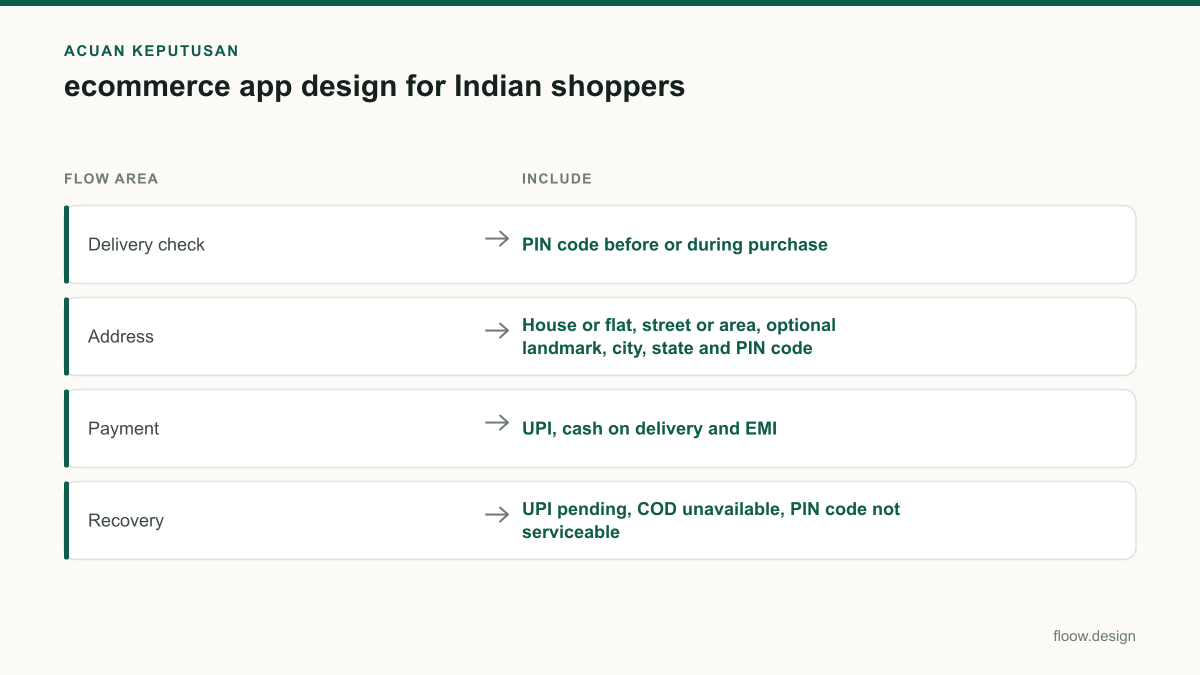
| Flow area | Include | Why it matters |
|---|---|---|
| Delivery check | PIN code before or during purchase | Lets the app communicate serviceability and delivery context early. |
| Address | House or flat, street or area, optional landmark, city, state and PIN code | Supports multi-line Indian delivery addresses without forcing one overloaded field. |
| Payment | UPI, cash on delivery and EMI | Matches the payment choices shoppers may need to compare at checkout. |
| Recovery | UPI pending, COD unavailable, PIN code not serviceable | Keeps customers in control when the happy path fails. |
Common mistakes
Putting PIN-code validation only after payment selection.
Check the PIN code on the product or cart journey and repeat the current delivery context in checkout.
Using one mandatory address textarea for every delivery detail.
Provide separate address lines and an optional landmark, while retaining a clear reviewable address summary.
Treating COD as a generic payment method with no order-specific status.
Show COD availability and the payable amount before the final order action, including a clear reason when it cannot be used.
Showing a UPI success screen as soon as the customer leaves for another app.
Use a pending state until the payment result is confirmed, then offer retry or an alternative payment method if needed.
Frequently asked questions
What should ecommerce app design include in India?
ecommerce app design in India should include early PIN-code delivery checks, a structured multi-line address form with an optional landmark, and clear UPI, cash on delivery and EMI choices. It should also show delivery context, payment status, order confirmation and recovery states for unavailable COD, invalid PIN codes and interrupted UPI payment handoffs.
How should COD work in a shopping app?
COD in an Indian shopping app should appear as a clear payment option with the order’s payable amount and eligibility shown before the customer places the order. If COD is unavailable for a PIN code, basket or address, explain it near the payment option and keep UPI and EMI available as alternatives where the merchant supports them.
Why are PIN code checks important in Indian ecommerce?
PIN-code checks are important in Indian ecommerce because the delivery location affects whether an order can be served and what delivery information the app can show. Ask for the PIN code early, preserve the shopper’s typed address if it changes, and use the result to guide address completion, payment eligibility and delivery expectations.
How can I test an India-specific mobile checkout?
Test an India-specific mobile checkout as a connected flow: product delivery check, cart, PIN-code validation, multi-line address entry, UPI, COD and EMI selection, payment return and order confirmation. Build invalid PIN code, COD-unavailable and UPI-pending states alongside the happy path. floow.design can generate these linked checkout, address and payment screens for review.
Where this leaves you
Indian commerce flows earn confidence through clear location, payment and recovery states. Build around PIN codes, flexible address capture, UPI, COD and EMI; then use floow.design to generate and test the complete mobile purchase journey in light and dark themes.
Design the screens first
Describe the app in plain language and floow.design draws the iOS and Android screens for you, ready to refine and hand off.
Sources
Design your mobile app with AI.
Generate pixel-perfect iOS and Android screens in seconds, then export to Figma or code.
You might also like…
 Guides20 September 2026ux writing for Indian mobile appsA practical guide to UX copy for Indian apps: UPI, OTP, KYC, payment failures, multilingual expansion and DPDP Act consent wording.By floow.design Team, Mobile Design
 Guides20 September 2026ui ux design services for Indian mobile appsPlan Indian mobile app UI/UX work: UPI, OTP, COD, multilingual journeys, DPDP Act privacy screens, handoff files and GST invoice scope.By floow.design Team, Mobile Design
 Guides20 September 2026Travel app design for Indian travellersDesign Indian travel booking screens for rail, buses, flights and stays with passenger details, PNR, UPI, GST invoices and cancellations.By floow.design Team, Mobile Design