
ui ux design course in karachi: mobile checklist
Use this Karachi checklist to compare UI UX courses by mobile screens, prototype depth, portfolio evidence, critique quality, and PKR fee terms.

A ui ux design course in karachi should make you design and test a complete mobile-app flow, not only attractive screens. Check for Android and iOS patterns, clickable prototypes, usability feedback, portfolio case studies, and transparent PKR fees. For fintech briefs, use familiar local contexts such as payments and account servicing around Karachi’s State Bank ecosystem.
Key takeaways
- •Choose a course by the mobile work students can show, not by software logos or a certificate alone.
- •Ask to inspect a finished student case study: problem, user flow, key screens, prototype, test findings, and revisions.
- •A credible app design portfolio should demonstrate Android and iOS decisions, including errors, permissions, loading states, and handoff detail.
- •Get the full PKR fee schedule, included tools, class format, mentor access, and refund terms in writing before paying.
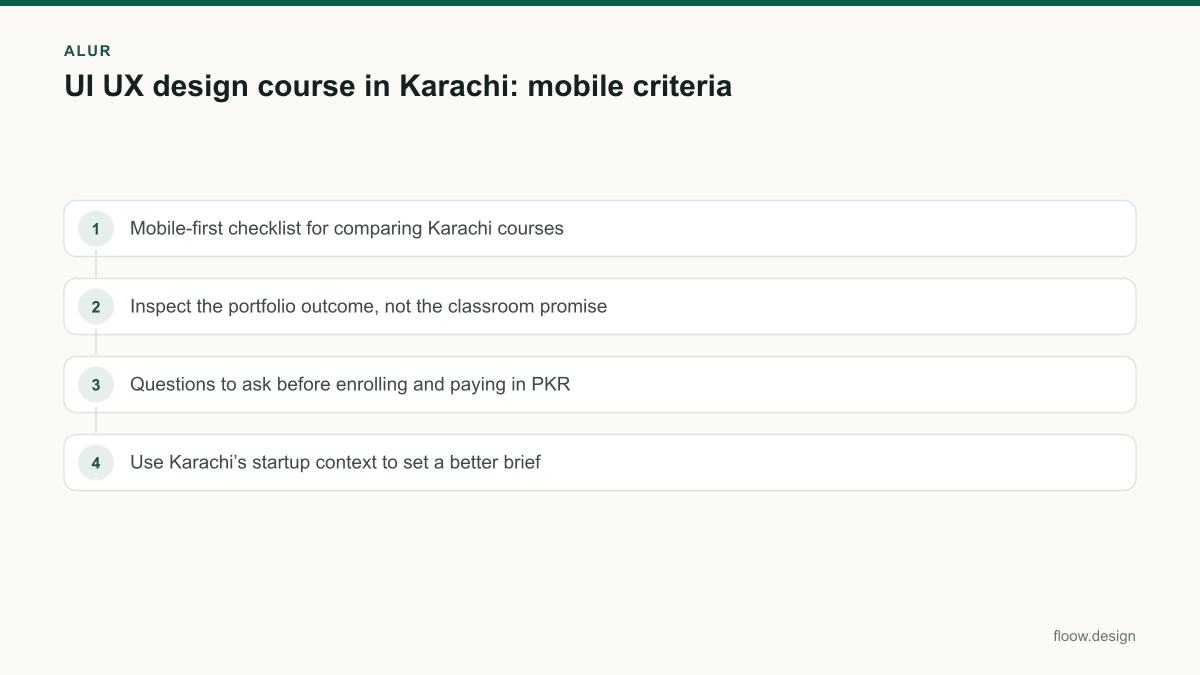
What's on this page
- •Mobile-first checklist for comparing Karachi courses
- •Inspect the portfolio outcome, not the classroom promise
- •Questions to ask before enrolling and paying in PKR
- •Use Karachi’s startup context to set a better brief
Mobile-first checklist for comparing Karachi courses
Karachi is the capital of Sindh province, and its student market includes agencies, product teams, and early-stage companies. That makes a course more useful when its assignments resemble the mobile work those teams review: a task flow, a usable prototype, and a documented rationale—not a gallery of unrelated landing pages.
Use this checklist during a trial class or portfolio review:
- •Start with a user task. The brief should define a user, goal, constraint, and success condition.
- •Map the app flow. Look for onboarding, navigation, forms, search, empty states, errors, confirmations, and support routes.
- •Design for both platforms. The instructor should explain when Android conventions and iOS conventions differ rather than forcing one visual pattern everywhere. Refer to Android Developers and Apple Developer guidance.
- •Prototype and test. Ask whether students watch target users attempt tasks and revise screens from findings.
- •Explain handoff. A strong final project includes component states, spacing, copy, asset notes, and interaction behaviour for developers.
If a course promises UI skills but cannot show this sequence in a former student project, treat its mobile-app claim cautiously.
Inspect the portfolio outcome, not the classroom promise
Ask to see two or three completed student case studies without the instructor narrating around gaps. A credible ui ux designer portfolio tells a reviewer what was designed, why it changed, and how the final mobile flow works.
For each project, check for these artifacts:
- •A short problem statement and a clearly defined audience.
- •A task flow before high-fidelity app design.
- •Screens beyond the happy path: validation, no connection, permissions, empty results, cancellation, and completion.
- •A clickable prototype with realistic transitions and input behaviour.
- •Evidence of critique or usability testing, followed by specific revisions.
- •A tidy Figma file: named frames, reusable components, variants, and understandable styles.
Karachi is also home to the State Bank of Pakistan, whose headquarters are in the city. That is a useful local context for judging a fintech exercise: a payment or account-management concept should communicate amounts in PKR, show a confirmation state, and make errors understandable. It does not need to imitate a real bank. The point is to demonstrate careful mobile interaction design in a familiar domain. Confirm the institution’s location through the State Bank of Pakistan.
Questions to ask before enrolling and paying in PKR
Treat the enrolment conversation like a product review. Ask for answers that can be demonstrated in class materials, student files, or a written fee document.
- •Which weeks are dedicated specifically to mobile app design rather than websites?
- •Will I complete an Android and iOS flow, or only make static screens?
- •How many individual critiques will I receive, and who gives them?
- •Can I view anonymised student case studies and their source Figma files?
- •Does the course cover research planning, usability sessions, synthesis, and iteration?
- •What software, plugins, device access, and portfolio-review support are included?
- •What is the complete fee in PKR, the instalment schedule, and the written policy for cancellation or missed classes?
Do not use the lowest headline fee as the deciding measure. Compare the amount against teaching hours, live critique, the number of portfolio projects, and whether the final output is a testable mobile prototype. Ask whether a certificate is conditional on attendance, project completion, or an additional assessment. Written answers reduce misunderstandings later and make one Karachi institute easier to compare with another.
Use Karachi’s startup context to set a better brief
NIC Karachi is part of Pakistan’s National Incubation Center network. That context is useful because early-stage teams need designers who can turn an uncertain product idea into a focused first-release flow, rather than decorate every possible feature. Verify the network context with Ignite National Technology Fund.
Before committing to a course, create a Karachi-market app portfolio brief in floow.design. Choose a believable audience and one narrow task—for example, discovering a service, booking an appointment, tracking an order, or managing a PKR payment request. Define the primary screen set: entry, onboarding or sign-in, home, task completion, confirmation, and recovery from an error.
Then take that brief to each admissions call. Ask the institute to explain how its curriculum would improve the flow through research, wireframes, visual hierarchy, prototype testing, and iteration. Their answer reveals whether they teach a repeatable process or only Figma commands. Keep the floow.design output as a baseline, then document what you change after critique; that comparison becomes strong evidence in your portfolio.
Common mistakes
Choosing a course because it teaches Figma.
Require proof that Figma is used to create flows, component states, clickable prototypes, and developer-ready documentation.
Submitting only polished home screens in a portfolio.
Show the complete mobile journey, including form validation, empty states, error recovery, and final confirmation.
Paying a PKR fee from a promotional post without checking terms.
Request the total payable amount, instalments, included services, attendance rules, and cancellation policy in writing.
Using a generic global brief that does not show product judgment.
Create a Karachi-market brief in floow.design and explain the user task, local currency display where relevant, and the decisions made after testing.
Frequently asked questions
Which UI UX design course in Karachi teaches mobile apps?
A UI UX design course in Karachi teaches mobile apps when its syllabus requires students to create end-to-end Android or iOS flows, build clickable prototypes, test tasks with users, and revise the work. Ask to see completed student case studies with error, empty, loading, permission, and confirmation states—not just visually polished screens.
What should I ask a Karachi UI UX institute?
Ask a Karachi UI UX institute how many mobile projects you will finish, whether you receive individual critique, whether you can inspect former student case studies and Figma files, and how usability testing is taught. Also request the full PKR fee, instalment dates, included software or mentoring, attendance requirements, and cancellation terms in writing.
How much should a UI UX course cost in PKR?
There is no single dependable PKR price for a UI UX course because duration, live mentoring, class size, portfolio reviews, and software access vary. Compare the total PKR amount against the number of critique sessions, completed mobile case studies, and prototype-testing practice. Ask for all instalments and any extra charges before enrolment.
Should I make a portfolio brief before choosing a UI UX course?
Yes. Create a focused Karachi-market mobile-app brief in floow.design before choosing a UI UX course. Use it to ask each institute how it would guide you from user task and flow mapping to prototype testing and final case study. The specificity of its answer is more informative than a generic promise to teach UI and UX.
Where this leaves you
Select a course that can move your floow.design brief through research, mobile flows, prototype testing, revision, and a documented case study. In Karachi, that evidence will carry more weight than a certificate or a collection of attractive but disconnected screens.
Design the screens first
Describe the app in plain language and floow.design draws the iOS and Android screens for you, ready to refine and hand off.
Sources
Design your mobile app with AI.
Generate pixel-perfect iOS and Android screens in seconds, then export to Figma or code.
You might also like…
 How-to20 September 2026how to start freelancing in pakistan: UI checklistA practical checklist for Pakistan-based UI designers: build a three-screen sample, package mobile deliverables, quote clearly, and collect payments.By floow.design Team, Mobile Design
 Guides20 September 2026UI of website to mobile app: Pakistan handoffTurn a Pakistani service website into focused app screens: map core journeys, use PKR checkout patterns, and prepare a practical handoff for floow.design.By floow.design Team, Mobile Design
 Insights20 September 2026ui ux designer salary in pakistan: mobile rolesCompare mobile UI UX offers in Pakistan by PKR pay, city, product scope, employment type, tax, benefits and a portfolio-led negotiation plan.By floow.design Team, Mobile Design