
Prototype a Pakistan mobile app before building
Prototype Pakistan app flows for trust, address entry, CNIC context and cash on delivery, then run focused usability testing before development.

To prototype a mobile app in Pakistan, build a tappable flow around the riskiest local task: establishing trust, entering an address, verifying an identity context such as a NADRA-issued CNIC, or choosing cash on delivery. Test it with target users in markets such as Karachi, Lahore, Islamabad, Rawalpindi, and Faisalabad before committing to mobile app development.
Key takeaways
- •Start with one high-risk task rather than prototyping every screen.
- •Test address capture, trust cues, CNIC-related wording, and payment choice with realistic scenarios.
- •Include cash on delivery where it fits the commerce model; do not force a digital-payment-only flow.
- •Recruit participants from the city, device mix, and user segment you intend to serve.
- •Use floow.design to create a tappable flow, observe task completion, and revise before development begins.
What's on this page
- •Choose the first task to prototype
- •Design for trust, identity context, and payment choice
- •Run usability testing before mobile app development
- •Turn findings into a build-ready decision
Choose the first task to prototype
A prototype is most useful when it answers a product risk, not when it demonstrates every feature. For Pakistan concepts, that risk is often whether a person trusts the service enough to continue, can enter a usable delivery or service address, understands an identity step, or can select a suitable payment method.
Write one scenario in plain language: “Order household items for delivery to my home and choose how to pay,” or “Create an account and understand why my identity information is requested.” Then map only the screens needed to complete it: entry point, key form fields, review state, confirmation, and an understandable failure or edit path.
Use realistic city scenarios. Karachi and Lahore may expose dense-neighbourhood address patterns; Islamabad and Rawalpindi can reveal how users describe nearby sectors, streets, or landmarks; Faisalabad is a useful check that the flow is not shaped only by the largest digital-product teams. Do not assume a single address format works everywhere. Ask testers to enter their own address in the way they naturally would, then see whether your fields and validation support it.
Create a tappable flow in floow.design to test this highest-risk local task before development.
Design for trust, identity context, and payment choice
Trust should be visible at the decision point, not buried in a policy screen. If your service requests identity information, explain what is requested, why it is needed, and what happens next immediately before the form. NADRA-issued CNIC details are a familiar identity context in Pakistani services, but familiarity does not remove the need for a clear purpose statement, restrained data collection, and an obvious way to correct an entry.
Prototype the language around identity separately from the field layout. In a test, ask participants what they think will happen after entering their details. If they cannot explain it accurately, shorten the copy or move the explanation closer to the action.
For a commerce journey, make payment choice a real branch of the prototype. Cash on delivery remains a relevant option in Pakistan’s commerce ecosystem, so test whether users can find it, understand any order confirmation step, and change their choice before placing an order. Do not label a payment method as “recommended” without learning whether that cue creates confidence or pressure.
Also prototype recovery: an invalid phone number, an incomplete address, a changed payment method, or a cancelled order. These moments often determine whether a user believes the app is dependable.
Run usability testing before mobile app development
Recruit people who resemble the first audience, not only colleagues who already understand apps and product language. A practical first round is a small set of individual, moderated sessions across your intended customer segments. Include people from the launch city or cities and, where relevant, a mix of Android devices, experience levels, and payment preferences.
Give tasks, not instructions. Say, “You need this delivered to your address and prefer to pay when it arrives,” rather than “Tap cash on delivery.” Stay quiet while they work. Ask follow-up questions after the task: What did you expect? What made you hesitate? What information was missing? Record where they pause, go back, abandon the flow, or ask for reassurance.
For each task, capture completion, time spent, wrong turns, confidence, and exact words users use for places, identity details, and payment. Sort findings by consequence. Fix blockers first: users cannot complete an address, do not understand why CNIC-related information is needed, or cannot locate their preferred payment method. Then test the revised prototype with new participants.
This is cheaper and faster than discovering the same issues after mobile app development has locked in navigation, validation, and backend assumptions.
Turn findings into a build-ready decision
Finish the prototype cycle with decisions that engineers and product owners can act on. For each tested screen, record the user goal, the required information, the accepted input patterns, the error state, and the evidence behind the choice. A note such as “three participants expected a landmark field after entering their street” is more useful than “improve address UX.”
Separate what the prototype proved from what still needs technical validation. A tappable flow can show that people understand an address form; it cannot prove delivery coverage, payment authorization, identity verification, or notification reliability. Mark these as build-stage dependencies rather than pretending they are solved.
Prioritise the next iteration by adoption risk. If testers abandon before checkout because the delivery address feels uncertain, do not spend the next cycle refining icons. If they understand the flow but question the identity request, revise the explanation and minimise the information requested in the prototype before designing more account screens.
Hand the final flow to development with a short task script, annotated states, and a list of unresolved assumptions. That keeps the first release focused on a journey users in Pakistan can understand and complete.
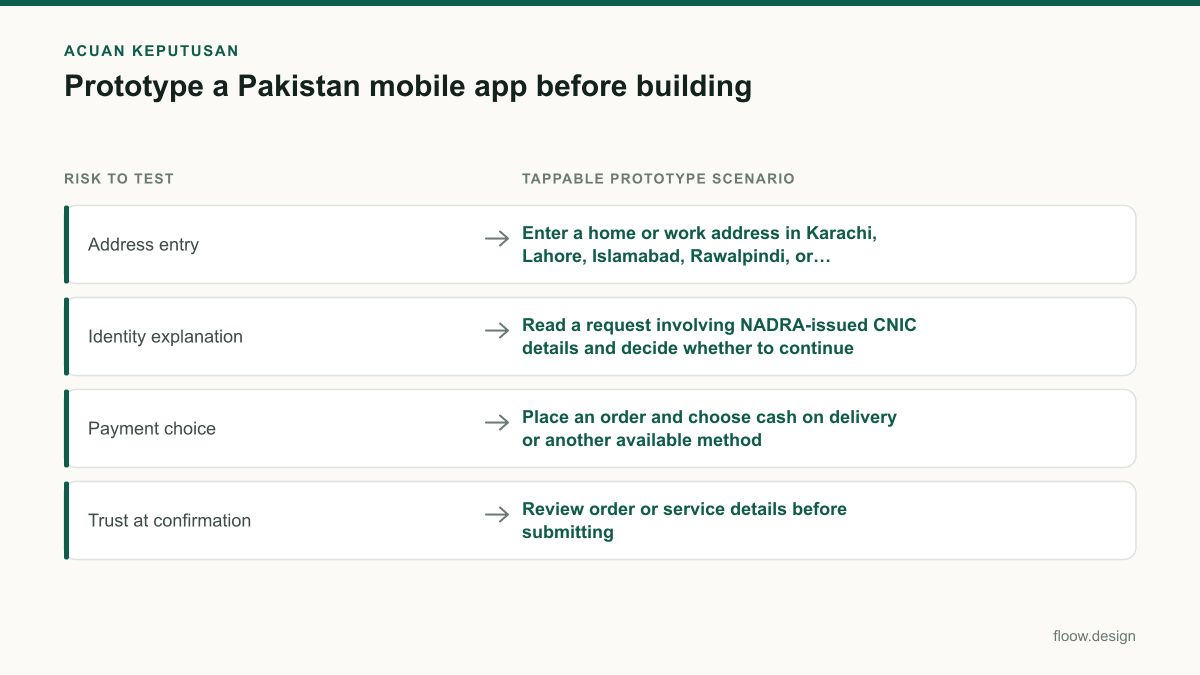
Prototype test scenarios for a Pakistan commerce or service app
| Risk to test | Tappable prototype scenario | What to observe |
|---|---|---|
| Address entry | Enter a home or work address in Karachi, Lahore, Islamabad, Rawalpindi, or Faisalabad | Whether users need landmark, area, sector, street, or edit options |
| Identity explanation | Read a request involving NADRA-issued CNIC details and decide whether to continue | Whether users understand why details are requested and what happens next |
| Payment choice | Place an order and choose cash on delivery or another available method | Whether the preferred option is visible, understood, and reversible |
| Trust at confirmation | Review order or service details before submitting | Whether users can state price, address, payment choice, and next step |
Common mistakes
Testing a polished home screen instead of a risky end-to-end task.
Prototype one complete journey, including entry, form completion, review, confirmation, and recovery from an error.
Treating address entry as a generic international form.
Let participants enter real addresses naturally, then adapt labels, optional fields, validation, and landmark support to observed behaviour.
Requesting CNIC-related details without an immediate explanation.
Place a concise purpose statement beside the request and test whether participants can accurately describe the reason for it.
Making digital payment the only visible checkout route for a commerce concept.
Where the model supports it, include cash on delivery in the prototype and test discovery, confirmation, and switching between options.
Frequently asked questions
How do I prototype a mobile app in Pakistan?
To prototype a mobile app in Pakistan, choose one adoption-critical journey, such as sign-up, address entry, booking, or checkout, and create a tappable version before coding. Use realistic scenarios from your launch market, explain any NADRA-issued CNIC-related request clearly, and include cash on delivery when it is relevant to the service. Test the flow with intended users, revise blockers, then hand annotated screens to development.
Who should test my app prototype?
Your app prototype should be tested by people who match the intended users in Pakistan, not only friends, employees, or designers. Recruit participants from the launch city and relevant segments, such as first-time customers, frequent online shoppers, drivers, sellers, or small-business owners. Include varied device confidence and payment preferences, then observe each person completing realistic tasks without step-by-step guidance.
What should I test before development?
Before development, test whether users can understand the value proposition, create an account, enter an address, complete the core action, recover from mistakes, and understand the confirmation state. In Pakistan, also test trust language around NADRA-issued CNIC details where applicable and payment selection, including cash on delivery for relevant commerce flows. Prioritise failures that prevent completion or create doubt.
How many prototype tests should I run before building?
Run enough prototype sessions to expose repeated failures in the core journey, then retest after meaningful changes with new participants. Start with a focused moderated round rather than a large survey. If several people independently struggle with address entry, payment choice, or an identity explanation, treat that as a design issue worth fixing before mobile app development.
Where this leaves you
A useful Pakistan app prototype does not attempt to predict every feature. It proves that people can trust the service, describe where they are, understand any identity request, and choose a payment route that works for them. Build and test that tappable journey in floow.design first; use the evidence to decide what deserves development effort.
Design the screens first
Describe the app in plain language and floow.design draws the iOS and Android screens for you, ready to refine and hand off.
Sources
- •National Database and Registration Authority (NADRA)
- •State Bank of Pakistan
- •Pakistan Bureau of Statistics
Related reading
Design your mobile app with AI.
Generate pixel-perfect iOS and Android screens in seconds, then export to Figma or code.
You might also like…
 Guides20 September 2026ui ux design for Pakistani service appsDesign Pakistani service-app flows from discovery to booking, PKR payments and support, with practical screen priorities, states and prototype tests.By floow.design Team, Mobile Design
 How-to20 September 2026mobile app development: Pakistan design handoffA Pakistan mobile UI handoff checklist for PKR, Urdu right-to-left layouts, Raast payment states, prototypes, and a build-ready design system.By floow.design Team, Mobile Design
 How-to20 September 2026figma tutorial for Pakistani mobile app flowsLearn a figma tutorial for Pakistani bilingual payment and booking flows: Urdu RTL layouts, +92 sign-up, reusable PKR price components, and prototypes.By floow.design Team, Mobile Design