
ui and ux design for Pakistan mobile apps
A mobile-first workflow for Pakistan apps: research language, PKR cash journeys, CNIC inputs and device-aware onboarding before building screens.

ui and ux design for Pakistan’s mobile users should begin with real task journeys: onboarding, payment, identity entry and completion states. Design for Pakistan’s legal-tender currency, PKR; test language and literacy choices with target users; and treat CNIC-related fields as sensitive, purposeful inputs rather than default form clutter.
Key takeaways
- •Build and test the smallest mobile journey first: onboarding, the core task and a clear completion state.
- •Make PKR amounts, cash alternatives and payment status explicit at every transaction step.
- •Use CNIC-related inputs only when the service genuinely needs them, with clear purpose, formatting help and privacy context.
- •Separate national identity needs from device-registration needs: NADRA handles identity and civil registration, while PTA’s DIRBS concerns device identification, registration and blocking.
What's on this page
- •Start with a Pakistan-specific user persona
- •Use design thinking to turn research into mobile screens
- •Design identity and device steps without conflating them
- •A practical review before handoff
Start with a Pakistan-specific user persona
A useful user persona is defined by a task and a constraint, not by a generic age range. Interview people who actually need to register, pay, receive confirmation or recover access on a phone. Ask which language they read comfortably, whether they complete payments digitally or with cash support, who helps them with forms, and what proof they expect after a transaction.
Map the journey in small steps: open app, understand value, enter details, choose payment, receive status, and find help if something fails. This exposes where labels, number formats or error messages block progress. For financial flows, show amounts as PKR consistently: Pakistan uses PKR as its legal-tender currency. Do not hide fees, pending states or the final charged amount behind a late confirmation screen.
For identity tasks, distinguish the responsible institutions in your research notes. NADRA is Pakistan’s national identity and civil-registration authority. That context helps a team understand why users may be cautious about identity data, but it does not automatically justify collecting it. Source: State Bank of Pakistan and NADRA.
Use design thinking to turn research into mobile screens
Apply design thinking as a screen-making loop: observe a real task, define the point of failure, sketch alternatives, test a tappable prototype, then revise from evidence. Keep the first prototype narrow. A team designing a utility, marketplace or financial flow can validate onboarding, the primary task and the completion receipt before expanding navigation or adding secondary features.
Start the workflow in floow.design by generating the first onboarding and task-completion screens. Give the prompt concrete constraints: the user’s goal, the language choice to test, whether payment is cash or digital, the PKR amount display, and the exact proof of completion the user needs. Then generate an error or pending variant for the same task. A success screen without a recovery path creates false confidence.
Test on mobile devices with realistic text length and one-handed reach. Watch participants rather than asking whether they “like” a layout. Record where they hesitate, re-read, abandon a field or cannot tell whether the task finished. Use those observations to change hierarchy, copy and field order—not merely colours or icons.
Design identity and device steps without conflating them
CNIC-related input deserves a deliberate pattern when a service has a legitimate reason to request it. Explain why the field is needed before entry, use a visible example of the expected format, allow correction without wiping the form, and avoid asking for identity information earlier than necessary. Show a specific error when the format is incomplete or invalid; “something went wrong” gives users no route forward.
Do not describe every identity or device check as the same process. PTA’s Device Identification Registration and Blocking System is known as DIRBS. DIRBS is relevant when your product’s journey genuinely involves device identification, registration or blocking; it is not a substitute label for CNIC verification. Keep device-related instructions, identity data and account recovery in separate screens or clearly separated sections so users know what they are being asked to provide and why.
For high-consequence flows, test the wording of consent, failure and escalation states with local users. Provide an accessible support route from the error state, preserve non-sensitive progress where appropriate, and never imply that a government authority has approved a service unless that is demonstrably true. Source: Pakistan Telecommunication Authority.
A practical review before handoff
Before engineering handoff, review each critical screen against the journey rather than against a component checklist. Can a first-time user identify the next action? Does the screen explain any CNIC-related request in plain language? Are PKR amount, fee, payment state and receipt understandable without opening another page? Can the user correct a number, retry a failed action or reach support?
Create a small test set for every core flow: empty input, partly completed input, valid completion, network interruption, pending outcome and rejected outcome. The set should include the real strings that will appear in the app, because translated or longer labels can change hierarchy and wrapping. Keep the same status vocabulary across onboarding, payment and support surfaces.
Finally, hand off behavior as well as visuals: field validation timing, keyboard type, masking rules, disabled-button conditions, loading state, retry action and confirmation details. This is where mobile ui and ux design becomes a buildable product specification rather than a collection of attractive screens.
Pakistan-specific checkpoints for mobile flow briefs
| Journey area | Design decision | Local context |
|---|---|---|
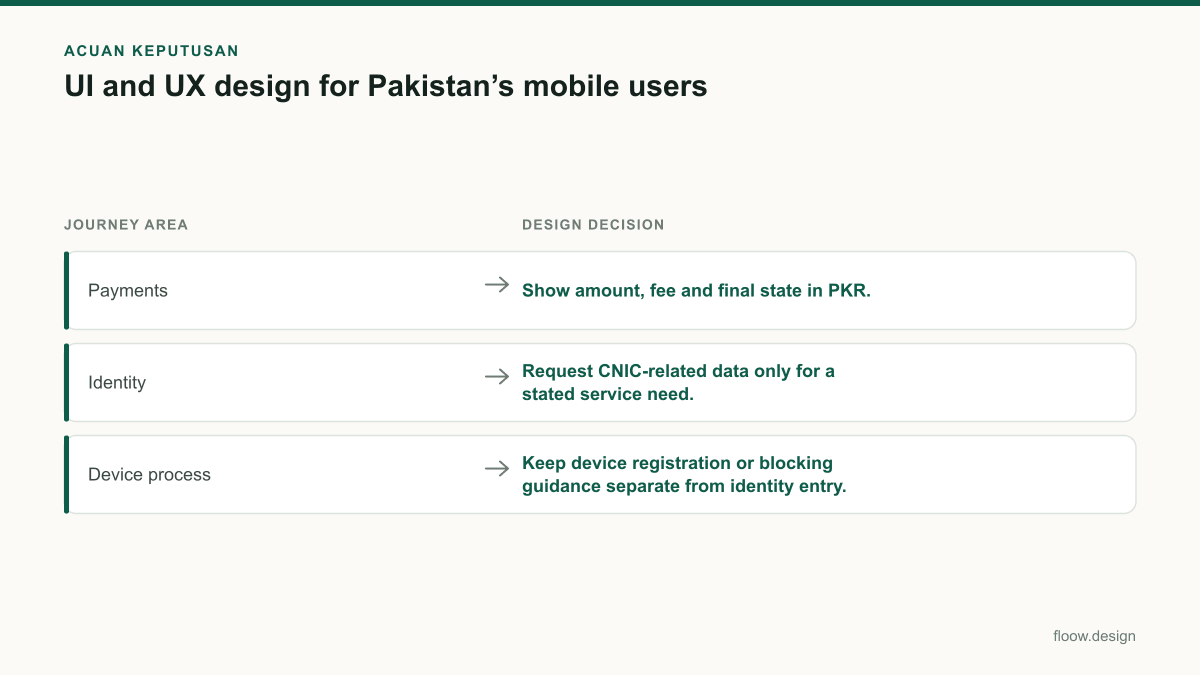
| Payments | Show amount, fee and final state in PKR. | PKR is Pakistan’s legal-tender currency. |
| Identity | Request CNIC-related data only for a stated service need. | NADRA is the national identity and civil-registration authority. |
| Device process | Keep device registration or blocking guidance separate from identity entry. | PTA’s Device Identification Registration and Blocking System is called DIRBS. |
Common mistakes
Treating CNIC as a default onboarding field.
Collect it only when the service needs it, explain the purpose before entry and provide format-specific validation.
Showing a price but not the payment outcome.
Display PKR amount, applicable fee, processing state and a durable completion or failure message.
Calling a device issue “verification” without explaining it.
Name the device-specific step clearly and use DIRBS only where device identification, registration or blocking is actually relevant.
Testing only the happy path.
Prototype empty, invalid, pending, interrupted and rejected states for each high-value task.
Frequently asked questions
How do UI and UX design work together?
UI and UX design work together by pairing what users see and touch with the task logic behind it. UI covers elements such as labels, fields, buttons and status messages; UX covers the journey, sequence, feedback and recovery when something fails. For a Pakistan mobile flow, both should make PKR amounts, identity requests and completion states understandable.
What should Pakistani app teams research first?
Pakistani app teams should first research the exact mobile task their target users are trying to finish, including language comfort, payment method, trust concerns and failure recovery. Interview and observe users completing a realistic journey. Establish whether the service genuinely needs CNIC-related data, whether cash is part of the journey, and what receipt or confirmation users expect.
Do apps need CNIC-related input patterns?
Apps need CNIC-related input patterns only when their service has a legitimate reason to collect or verify CNIC-related information. When needed, the pattern should state the purpose, show the expected format, validate errors clearly and let users correct entries easily. NADRA is Pakistan’s national identity and civil-registration authority, so teams should handle identity requests carefully and avoid unnecessary collection.
What is DIRBS in a mobile app journey?
DIRBS is the Pakistan Telecommunication Authority’s Device Identification Registration and Blocking System. A mobile app should mention DIRBS only when its journey genuinely concerns device identification, registration or blocking. It should not be presented as a general identity check or used to justify CNIC collection without a clear service-specific reason.
Where this leaves you
Build the first Pakistan flow around a real mobile task, not a generic template. Generate onboarding and completion states in floow.design, then test PKR clarity, identity-request wording, device-process separation and recovery paths with the people who will use the app.
Design the screens first
Describe the app in plain language and floow.design draws the iOS and Android screens for you, ready to refine and hand off.
Sources
- •State Bank of Pakistan
- •National Database and Registration Authority (NADRA)
- •Pakistan Telecommunication Authority (PTA)
Related reading
Design your mobile app with AI.
Generate pixel-perfect iOS and Android screens in seconds, then export to Figma or code.
You might also like…
 How-to20 September 2026User persona for Pakistan mobile app researchBuild a user persona for Pakistan mobile apps with practical fields for language, city, device and Easypaisa, JazzCash or bank/Raast payment access.By floow.design Team, Mobile Design
 How-to20 September 2026Design thinking for Pakistan mobile app problemsApply design thinking to a Pakistan payment-confirmation problem: research users, define friction, prototype mobile screens, and test locally.By floow.design Team, Mobile Design
 How-to20 September 2026Wireframe a Pakistani mobile payment flowLearn how to wireframe Pakistani transfer, cash-out and bill-payment screens with Raast IDs, wallet choices, error states and local user personas.By floow.design Team, Mobile Design