
ui ux design course for Pakistan: mobile career guide
Compare a ui ux design course in Pakistan by mobile-app practice, portfolio depth, Figma skills, feedback, pricing in PKR, and career outcomes.

A ui ux design course is useful for Pakistan learners when it teaches mobile product screens, not only visual mock-ups. Choose training with Figma practice, critique, usability testing, and portfolio case studies for real app flows. Compare total fees in Pakistani rupees (PKR), and use floow.design to create original mobile-screen exercises alongside the course.
Key takeaways
- •Prioritise courses that teach complete mobile flows: onboarding, authentication, home, search, payments or orders, states, and hand-off notes.
- •A certificate matters less than evidence that you can explain user problems, decisions, iterations, and mobile UI details in a portfolio.
- •Check all costs in PKR, including software, mentor access, portfolio reviews, and any optional certification.
- •Use floow.design alongside coursework to generate distinct mobile-screen briefs, then document your own design reasoning and revisions.
What's on this page
- •How to judge a course for Pakistan’s mobile-app market
- •Check credibility without confusing a course with a degree
- •Build a mobile portfolio while you learn
- •Questions to ask before paying for training
How to judge a course for Pakistan’s mobile-app market
A strong course should prepare you to design the screens a product team actually needs, rather than stopping at a landing page or a polished single dashboard. Ask to see the syllabus and student work before paying. It should cover user flows, information architecture, wireframes, mobile UI patterns, accessibility basics, prototypes, testing, and developer hand-off.
For each module, look for a mobile outcome. A figma tutorial is useful when it teaches components, variants, Auto Layout, reusable styles, prototyping, and organised files in the context of an app task. It is not enough to copy a pretty community file. You should be making choices: what appears on the first screen, what happens after an error, how a user goes back, and what the empty state says.
Also ask how feedback works. A working ui ux designer needs critique on hierarchy, task completion, copy, and interaction logic—not just comments on colour. Compare the complete fee in Pakistani rupees, abbreviated PKR, which is Pakistan’s official currency. Do not assume a low headline price includes live reviews, recordings, or portfolio feedback.
Check credibility without confusing a course with a degree
In Pakistan, the Higher Education Commission (HEC) is the national higher-education regulator. If a provider presents its programme as a university qualification, verify the institution and its claims through the official HEC site rather than relying on an ad, a social post, or a certificate preview. A short professional course can still be valuable, but describe it honestly as skills training unless it is part of a recognised academic programme.
Use the provider’s sample lessons to test practical depth. Can students explain a user journey, map task steps, create wireframes, and revise a prototype after feedback? Can they show the file structure behind the final screen? These are better signals than a promise of instant placement.
DigiSkills.pk is a Pakistani government-backed online training initiative and can be a useful reference point for learners comparing accessible online skills training. Review its current catalogue and course format directly at DigiSkills.pk. Whether you choose a public initiative, university-linked study, or an independent cohort, decide based on the work you will make and the feedback you can receive.
Build a mobile portfolio while you learn
Treat every assignment as a case-study opportunity, but do not submit cloned marketplace screens as your main evidence. Build three to four compact mobile-product exercises with different user tasks. For example, design a service discovery flow, a booking or order flow, a personal finance tracker, or a support journey. The subject matters less than the quality of the problem framing and the flow.
Each case study should show the starting problem, target user, assumptions, journey or flow, low-fidelity exploration, final key screens, prototype behaviour, and what changed after critique or testing. Include difficult states: invalid input, no results, slow loading, permission denial, success confirmation, and cancellation. These states show that you understand product work beyond a static hero screen.
Use floow.design alongside coursework to produce original mobile-screen portfolio exercises. Start with a brief you have written, generate alternate screen directions, then select and adapt one in Figma. Record what you changed and why. That preserves your authorship: the portfolio should demonstrate your decisions, not imply that generated output is your entire process.
Questions to ask before paying for training
Ask for a live or recorded walkthrough of a complete student project. Check whether the programme teaches one responsive website and labels it UI/UX, or whether it genuinely addresses mobile app navigation, touch targets, keyboards, forms, notifications, and platform conventions. A mobile-first course should include prototypes that someone can tap through on a phone.
Ask who reviews work, how often, and whether feedback is specific. “Make it cleaner” is weak feedback; “the primary action competes with the filter, and the error state does not tell the user how to recover” is useful feedback. Ask if you retain access to materials, whether there are deadlines, and whether your final project can be publicly shown.
Finally, write down the total commitment before comparing options: tuition in PKR, expected weekly hours, required device, internet needs, Figma plan if applicable, and any separate mentor fee. A course is a commercial purchase, so make the decision on deliverables and support, not on a generic claim that UI/UX is in demand.
Pakistan-specific checks to make before enrolling
| Item | What to verify | Why it matters |
|---|---|---|
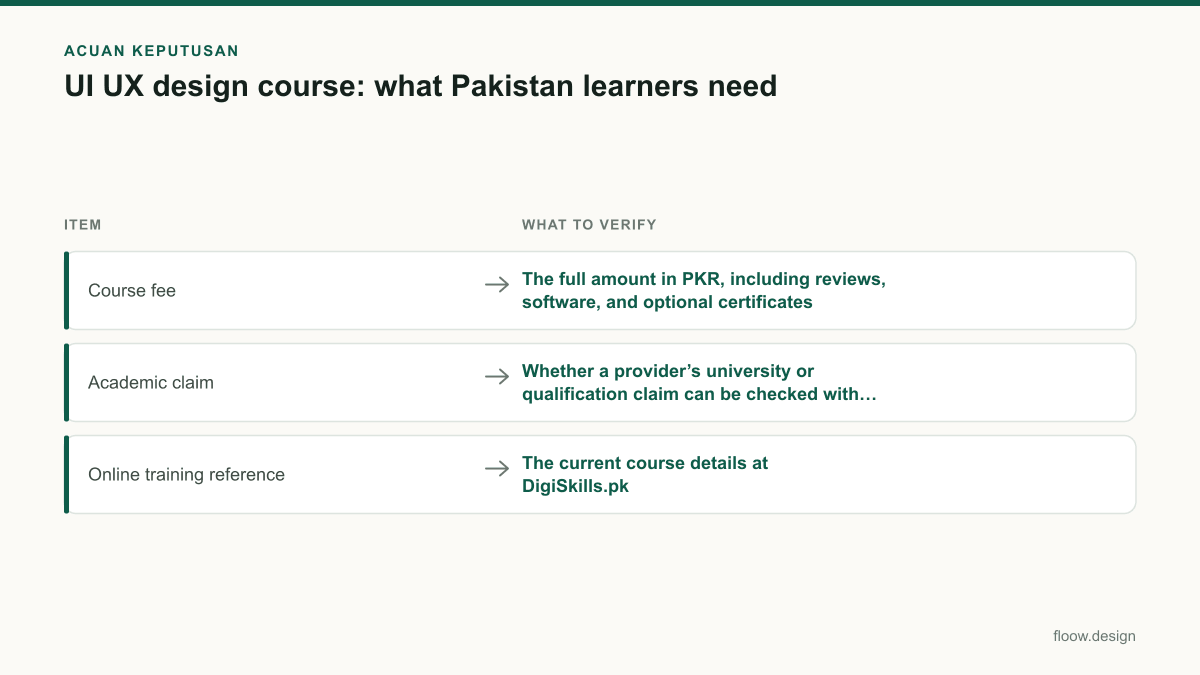
| Course fee | The full amount in PKR, including reviews, software, and optional certificates | Pakistan’s official currency is the Pakistani rupee (PKR), so compare the complete local cost rather than a promotional headline. |
| Academic claim | Whether a provider’s university or qualification claim can be checked with HEC | HEC is Pakistan’s national higher-education regulator; professional training and recognised higher-education qualifications are not the same thing. |
| Online training reference | The current course details at DigiSkills.pk | DigiSkills.pk is a Pakistani government-backed online training initiative, so its official information is a useful local reference when comparing formats. |
Common mistakes
Choosing a course because its gallery contains glossy single screens.
Request a full case study showing flows, wireframes, prototype links, feedback, and edge states.
Treating Figma tool lessons as proof of UX ability.
Use Figma to document research assumptions, task flows, hierarchy decisions, tests, and iterations—not only final visuals.
Listing copied redesigns without explaining your contribution.
Create original briefs with floow.design, redesign the generated directions in your own file, and state your decisions and revisions.
Comparing only advertised tuition.
Calculate the complete cost in PKR, including mentor access, software, portfolio reviews, and the time required.
Frequently asked questions
Is a UI UX design course worth it in Pakistan?
A UI UX design course can be worth it in Pakistan if it gives you structured mobile-app practice, specific critique, and portfolio case studies you can explain in interviews. It is less useful when it only teaches copied Figma screens or offers a certificate without feedback. Compare the complete cost in PKR against the projects, mentor access, and review quality included.
What should a UI UX course portfolio include?
A UI UX course portfolio should include original mobile case studies that show the user problem, target user, task flow, wireframes, final screens, prototype behaviour, and iterations after feedback or testing. Include practical states such as loading, empty, error, and success. Use floow.design for original exercise directions, then clearly show your own design choices and refinements.
Should a course teach mobile app design?
Yes, a UI UX course should teach mobile app design when the learner wants product-design work. Mobile training should cover navigation, forms, touch interactions, onboarding, search, notifications, accessibility basics, error recovery, and clickable prototypes. A course that only produces desktop pages or isolated visual screens does not adequately demonstrate end-to-end mobile product design skills.
How can I verify a course provider’s academic claims in Pakistan?
To verify an academic claim in Pakistan, check the provider’s institution and qualification statements against the Higher Education Commission’s official information. HEC is Pakistan’s national higher-education regulator. A short UI/UX training certificate may still help build skills, but it should not be presented as a recognised degree unless the provider can substantiate that status.
Where this leaves you
Choose training that makes you practise the work a mobile product team will review: flows, screens, states, prototypes, critique, and clear case studies. Check academic claims carefully, compare the full cost in PKR, and build original exercises with floow.design alongside the syllabus. The result should be a portfolio that proves how you think as well as how you use Figma.
Design the screens first
Describe the app in plain language and floow.design draws the iOS and Android screens for you, ready to refine and hand off.
Sources
Design your mobile app with AI.
Generate pixel-perfect iOS and Android screens in seconds, then export to Figma or code.
You might also like…
 Insights20 September 2026ui ux jobs in lahore: mobile portfolio guideBuild a mobile portfolio for Lahore product roles: case-study proof, review-ready screens, and a focused application plan for UI UX designers locally.By floow.design Team, Mobile Design
 Insights20 September 2026ui ux designer role in Pakistan mobile teamsA practical career guide to UI/UX designer deliverables, design systems, prototypes, handoff, and team habits for Pakistan mobile products.By floow.design Team, Mobile Design
 Insights20 September 2026Learn UI with Pakistani app screen exercisesLearn UI through Pakistani mobile screen exercises: bilingual flows, Android-first constraints, and a Figma tutorial routine for a focused portfolio.By floow.design Team, Mobile Design