
startup in pakistan: MVP mobile UI playbook
Choose the essential mobile MVP screens for a Pakistani startup: onboarding, payments, trust, support and prototype tests before a full build.

A startup in pakistan should begin with the smallest mobile flow that tests its riskiest customer behaviour: discover, decide, pay or request, and receive confirmation. Design for PKR from the first price screen, then prototype the journey with realistic local names, addresses and support expectations before funding a full app build.
Key takeaways
- •Build one complete customer task before adding dashboards, referrals or broad settings.
- •Show prices, fees, discounts and order totals in PKR wherever customers make a decision.
- •Treat cash and digital payment as a product hypothesis to test, not a default feature list.
- •Use a clickable prototype to observe real customer behaviour before engineering integrations.
- •Make trust visible through clear status, receipts, support access and understandable permissions.
What's on this page
- •Choose the MVP around one local customer decision
- •The first screens worth designing
- •Decide cash and wallet behaviour with a test
- •Prototype before committing to a full build
Choose the MVP around one local customer decision
For a startup in pakistan, an MVP is not a reduced version of every future feature. It is one mobile path that proves or disproves a commercial assumption. Write that assumption in plain language: “A customer will complete a paid booking after seeing a PKR total and an available time slot,” or “A merchant will submit stock details from a phone without assisted onboarding.”
Turn it into a short screen sequence: entry point, value and eligibility, key input, review, payment or request, confirmation, and status. Each screen must move the user toward the same decision. If a screen does not reduce uncertainty, collect the data needed for fulfilment, or complete the transaction, remove it from version one.
Plan the operating budget and revenue logic in PKR, including delivery charges, deposits, commission, refunds and promotional discounts. A price field without the currency marker creates avoidable doubt. Use realistic PKR amounts in the prototype rather than placeholder figures, so founders can judge whether the offer still works at local purchasing levels.
The SECP is the regulator for company incorporation in Pakistan. Incorporation work can run alongside product discovery, but it should not become a reason to postpone customer testing. Keep the MVP scope tied to the customer task, while documenting business and payment decisions early enough for the company setup and operating plan.
The first screens worth designing
Start app design with the screens that let a customer complete the core job and let the team handle exceptions. For most transactional mobile MVPs, this means:
- •Welcome or entry screen — state the service, supported area or audience, and the next action.
- •Phone sign-in and verification — request only the identity information needed for the first transaction.
- •Browse, search or task-start screen — make the main action obvious; do not build a full content catalogue unless discovery is the risk being tested.
- •Detail and selection screen — show what the customer gets, what it costs in PKR, and any conditions.
- •Address, booking or fulfilment screen — collect location, time or delivery details only when needed.
- •Review and payment-choice screen — make total cost, chosen method and next step explicit.
- •Confirmation and tracking screen — provide an order, request or booking reference plus an easy support route.
- •Operator state screens — include empty, loading, failure, cancellation and unavailable-area states. These reveal whether the service can actually be run.
Avoid a separate investor-facing dashboard in the customer MVP. Founders need a lightweight internal view of requests and failures, but customers need a dependable first task. Build the customer flow first, then add the smallest operational tooling needed to fulfil it.
Decide cash and wallet behaviour with a test
Do not assume every Pakistani customer will use the same payment method. In the MVP, the payment screen should test the behaviour that matters to the business model: willingness to pay before fulfilment, preference for cash at delivery, or confidence in a supported digital method.
Use a clear choice architecture. Show Cash only where your operations can collect and reconcile it. Show a wallet or transfer option only when the team can support the confirmation, failure and refund paths behind it. For each method, display the final amount in PKR before commitment, name any charge, and explain what happens next. A payment option that cannot be reconciled by the team is not an MVP feature; it is an operations risk.
Create separate prototype branches for cash and wallet selection. During testing, ask users to narrate why they selected one route, then watch where they hesitate: at the total, at a requested permission, at account verification, or at the confirmation state. Record completion rate, abandonment point and support questions for each branch.
Do not put card, cash, wallet, bank transfer and credit on one early screen merely to look comprehensive. Start with the methods your fulfilment process can honestly handle, then expand after evidence shows demand.
Prototype before committing to a full build
A clickable prototype is the fastest way to expose a weak assumption before engineering work begins. In floow.design, build the complete happy path first, then duplicate only the states needed to test uncertainty: an invalid phone number, unavailable service area, failed payment, no results, cancelled order and support request.
Recruit people who resemble the first buying audience, not only friends from the startup team. Give each participant a realistic task without explaining the intended route. For example: find a service, select an option, check the PKR total, choose payment, and locate the confirmation. Observe where they pause and what they expect to happen next. Do not rescue them too early.
National Incubation Centers operate in cities including Karachi and Lahore, making them useful places to find founder communities, mentors and early test participants. Bring a testable flow rather than a slide deck: participants can react to an actual sequence, price presentation and failure state.
After each session, rank changes by risk. Fix misunderstandings that prevent completion before polishing visual details. Turn the startup’s highest-risk assumption into a testable mobile MVP in floow.design, then use the evidence to decide what earns a full build.
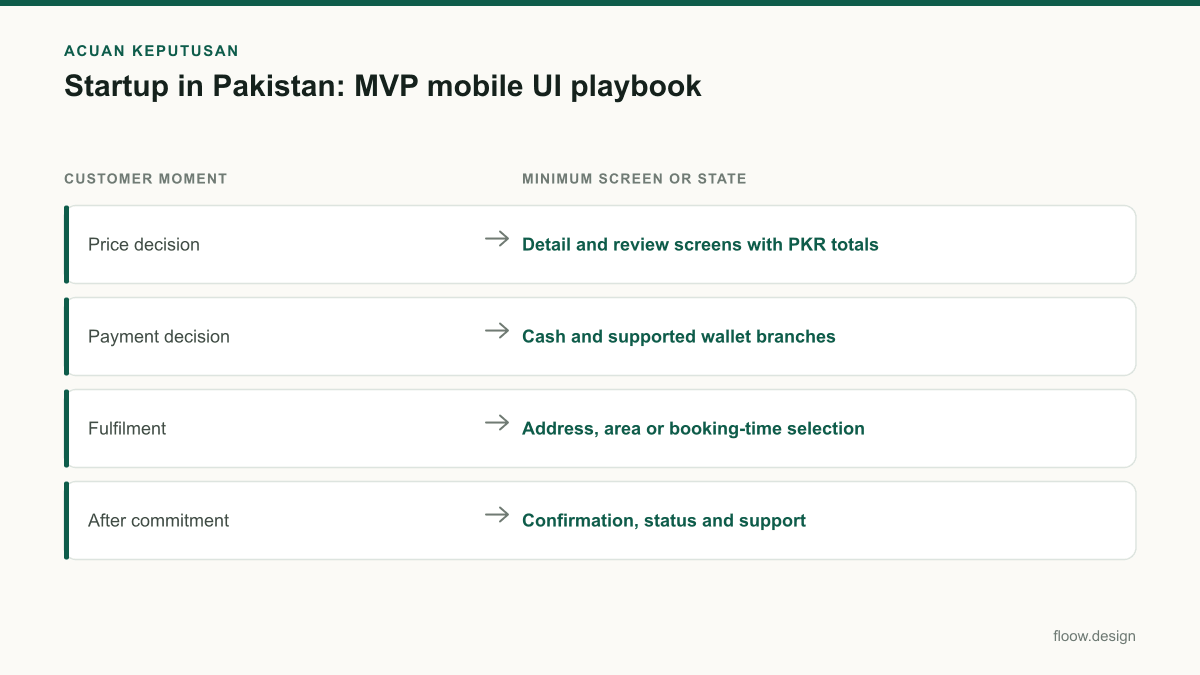
MVP screen decisions for a Pakistan-focused transactional app
| Customer moment | Minimum screen or state | What to validate |
|---|---|---|
| Price decision | Detail and review screens with PKR totals | Whether users understand the total and value before continuing |
| Payment decision | Cash and supported wallet branches | Which method users choose and whether operations can complete it |
| Fulfilment | Address, area or booking-time selection | Whether the service can be delivered as promised |
| After commitment | Confirmation, status and support | Whether users know what happens next and can resolve an issue |
Common mistakes
Copying a global feature checklist into the first release.
Build one end-to-end local customer task and postpone features that do not test the central purchase or request behaviour.
Showing prices without a clear PKR total, fee explanation or confirmation state.
Present the final amount in PKR before the user commits, then repeat it in the receipt or confirmation screen.
Adding digital payment options before the team can handle failed confirmations and refunds.
Prototype and operationally map each payment branch, including failure, cancellation, reconciliation and customer support.
Testing only the happy path with the founding team.
Test a clickable prototype with target users and include unavailable, invalid-input, cancellation and support states.
Frequently asked questions
What mobile screens should a startup in Pakistan build first?
A startup in Pakistan should first build the screens for one complete customer task: entry, phone verification where needed, task selection, detail, PKR price review, fulfilment details, payment or request, confirmation and support. Add loading, failure and unavailable states for that same task. Defer profiles, referrals, elaborate dashboards and broad settings until the core flow has been tested.
Should a Pakistani MVP accept cash or wallets?
A Pakistani MVP should offer cash, wallets or both only when the team can fulfil, reconcile and support the chosen method. Test payment preference in a clickable flow with a final PKR total and explicit next steps. Cash may test demand quickly, while a wallet path can test prepayment behaviour; neither should be added as decoration without an operational process behind it.
How do I test an MVP before development?
Test an MVP before development by creating a clickable prototype of one end-to-end mobile task, including price review, confirmation and common failure states. Give target users a realistic scenario, observe their choices without directing them, and record hesitation, abandonment and support questions. Prioritise fixes that challenge the business assumption, then repeat the test before committing engineering time.
Where can Pakistani founders find early MVP feedback?
Pakistani founders can recruit early MVP feedback from their target customer segment, local business communities and startup networks. National Incubation Centers operate in cities including Karachi and Lahore and can be useful places to meet founders, mentors and potential test participants. The best feedback comes from people who resemble the intended buyer and attempt a realistic mobile task.
Where this leaves you
A focused MVP earns its next build phase by proving one customer behaviour, not by displaying a long feature list. Design the PKR pricing, payment choice, fulfilment and support states that make that behaviour real. Turn the startup’s highest-risk assumption into a testable mobile MVP in floow.design.
Design the screens first
Describe the app in plain language and floow.design draws the iOS and Android screens for you, ready to refine and hand off.
Sources
- •Securities and Exchange Commission of Pakistan (SECP)
- •Ignite National Technology Fund — National Incubation Centers
Related reading
Design your mobile app with AI.
Generate pixel-perfect iOS and Android screens in seconds, then export to Figma or code.
You might also like…
 Guides20 September 2026ui ux design for Pakistani service appsDesign Pakistani service-app flows from discovery to booking, PKR payments and support, with practical screen priorities, states and prototype tests.By floow.design Team, Mobile Design
 How-to20 September 2026App design for Pakistan: local screen planPlan mobile app screens for Pakistan with local phone entry, Urdu-ready copy, Raast and wallet payments, low-data states, and practical support flows.By floow.design Team, Mobile Design
 Guides20 September 2026UI of website to mobile app: Pakistan handoffTurn a Pakistani service website into focused app screens: map core journeys, use PKR checkout patterns, and prepare a practical handoff for floow.design.By floow.design Team, Mobile Design